A more expensive certificate is not automatically the right certificate for a website. Domain Validation, usually shortened to DV, is sufficient for many projects when hostname coverage and deployment are correct. The decision should start with the identity requirement, the services being protected and the team responsible for maintaining them.
What DV actually validates
Domain validation checks that the applicant can demonstrate control over the requested domain using an accepted method. It does not independently assess the organization’s trading history, customer service or product quality. The resulting certificate supports hostname authentication without including the organization identity checks associated with OV.
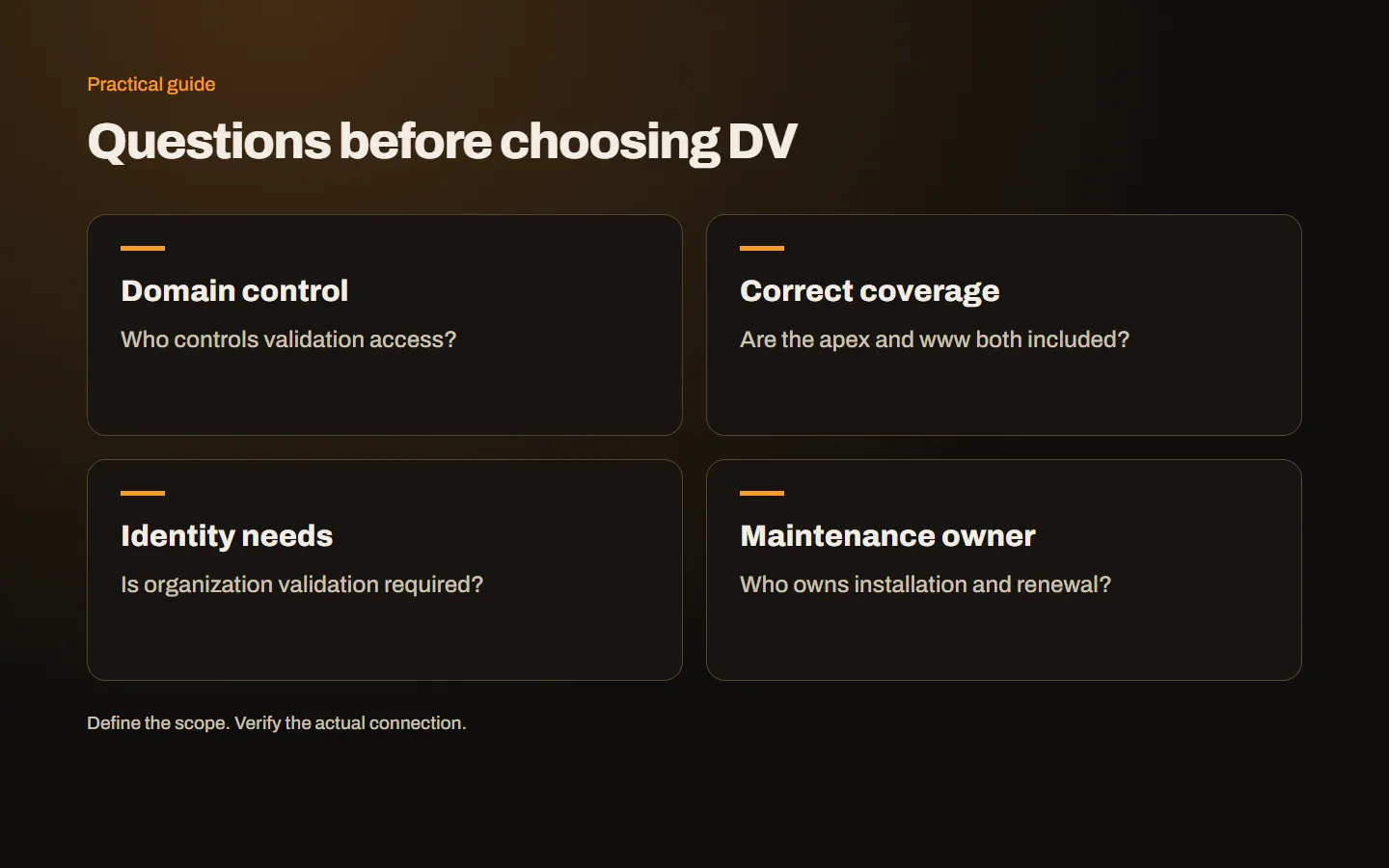
This distinction matters when access is fragmented. The developer may be able to edit a website but lack access to the authoritative DNS account. A former employee may control the registrar account. Before ordering, identify who can complete validation and where the relevant records are managed. Fixing account ownership is often the real prerequisite, rather than selecting a different certificate brand.
Projects where DV can be appropriate
Business presentation sites, blogs, portfolios and service websites can use DV when there is no separate organization validation requirement. A contact form does not technically require OV simply because visitors submit information. Likewise, higher visitor numbers do not independently turn DV into an unsuitable validation class.
Consider a consulting website with an apex address, a www alias and a contact form. If managed hosting already provides correctly configured automatic DV certificates, verifying that arrangement may be enough. If a business partner later requires verified organization identity, the decision changes because the requirements changed. It should not change merely because someone describes the site as more professional.
Can a login or store use DV?
An account application or store can technically serve HTTPS using DV. Validation class is not an encryption strength rating. Protocol configuration, keys and negotiated connection properties determine the technical connection, while OV adds an identity validation process. Avoid treating these as interchangeable levels on one scale.
The application still needs sound authentication, authorization, updates and payment integration. Check any written requirements from your provider or business partners rather than assuming that one rule applies to every store. Our e-commerce SSL guide explains why a secure checkout needs more than a certificate and why the entire shopping journey should be tested.
Free and paid DV offerings
A trusted free certificate can provide real HTTPS. Price differences may reflect support, installation assistance, management tools and commercial terms rather than a different degree of transport protection. Ask which tasks the supplier will perform and which remain with your team. A certificate-only purchase and a managed installation are different services.
If hosting includes automatic certificates, ask about subdomain coverage, error reporting and migration arrangements. Find out whether renewal alerts reach a monitored business account. The absence of an extra invoice does not remove the need for maintenance ownership. Equally, buying a paid product does not prove that the server is already presenting the new certificate correctly.
Check the exact names
The apex example.com and www.example.com are separate hostnames. A product may include both, but confirm this in the issued certificate rather than relying on the phrase single website. A portal or API address is another name to assess. Redirecting a hostname elsewhere does not eliminate its initial HTTPS validation requirement.
Create a small inventory with the hostname, service, hosting location and owner. Include legacy campaign addresses and administrative portals. Mail services may run on a different machine and require their own deployment. A certificate appearing in a web hosting panel does not mean it has automatically been installed on every service using the same parent domain.
Why validation can fail
Depending on the authority and product, validation may involve DNS, a specified web path or an available email method. Follow the current instructions for the actual order. Tokens from another request or records created in the wrong DNS zone will not complete the intended check.
If DNS is hosted separately, adding a record in the web hosting panel may have no public effect. Web validation can fail when requests reach another server or are blocked by a security rule. The Let’s Encrypt challenge documentation explains method differences. Use your chosen authority’s instructions for exact deployment details, particularly when automating validation across several servers.
When to consider a different arrangement
Choose organization validation when verified organization identity is required. Consider Wildcard coverage when many matching subdomains are centrally operated. These needs can coexist because coverage and identity validation answer different questions. Different registered domains may require separate certificates or a suitable multi-domain arrangement.
Avoid designing around speculative services that may never launch. Evaluate current services and confirmed near-term changes. Separate certificates can make sense when independent teams manage different security boundaries. Sharing a certificate and private key may simplify one task while increasing the number of systems affected by key replacement. Our Wildcard guide discusses that operational trade-off.
What to receive after installation
Ask for the covered hostnames, actual expiry and renewal method. Test HTTPS redirects, contact forms and account flows. Classify warnings before changing products: hostname mismatch, missing intermediates and mixed content need different remedies. A vague statement that SSL is broken is less useful than a record identifying the affected name and action.
The business owner does not need to run technical commands personally. Request evidence of an external connection check and the name of the maintenance owner. Review DNS access and alert addresses after a team change. A purchase confirmation does not prove issuance, and issuance does not prove deployment. Verify the certificate actually served to visitors after each renewal.
Two practical decision examples
Suppose the public website works but a customer portal shows a warning. First establish the portal hostname, its hosting location and its current certificate. If the name is missing, correct coverage. If it is already included, investigate the server mapping, chain or expiry. Upgrading from DV to OV without diagnosing the fault does not resolve these problems.
Now suppose a partner contract requires verified organization details. A working DV connection may still be insufficient for that documented identity requirement. OV is then considered for a specific reason. The same DV arrangement can therefore be suitable for one project and unsuitable for another without implying that its encryption became weaker.
Keep a short decision record
Write down the hostnames, identity requirement, hosting platform and renewal owner. Revisit it when adding an API, another domain or a contractual requirement, rather than whenever page numbers increase. Compare our DV SSL options, review the installation checklist, and contact us with your current setup if you would like help matching the certificate to the actual service.