
Moving to HTTPS does not independently solve search visibility, but it changes URLs and deserves careful migration planning. Redirects, canonical addresses and crawling signals need to agree. A poorly handled transition can send visitors to irrelevant destinations or leave search engines with conflicting versions. The goal is a secure, accessible site with consistent address signals.
Put HTTPS in its proper context
Secure delivery is part of a sound website experience. A certificate does not make an unhelpful article answer a visitor’s question, and it does not fix inaccessible navigation. Search performance depends on more than one technical feature. Avoid promises of a particular ranking position or traffic increase based on a certificate change.
Google’s page experience guidance encourages looking at the overall experience rather than optimizing a single indicator in isolation. For a business owner, the practical aim is straightforward: visitors reach the secure version, the page works and useful information is accessible. Treat HTTPS as a foundation alongside content, usability and reliable service delivery.
A protocol change is a URL change
The addresses http://example.com/product and https://example.com/product are different URLs even if their content looks identical. Old addresses need appropriate destinations, and internal signals should move to the secure version. Installing a certificate while leaving both versions independently available does not complete that transition.
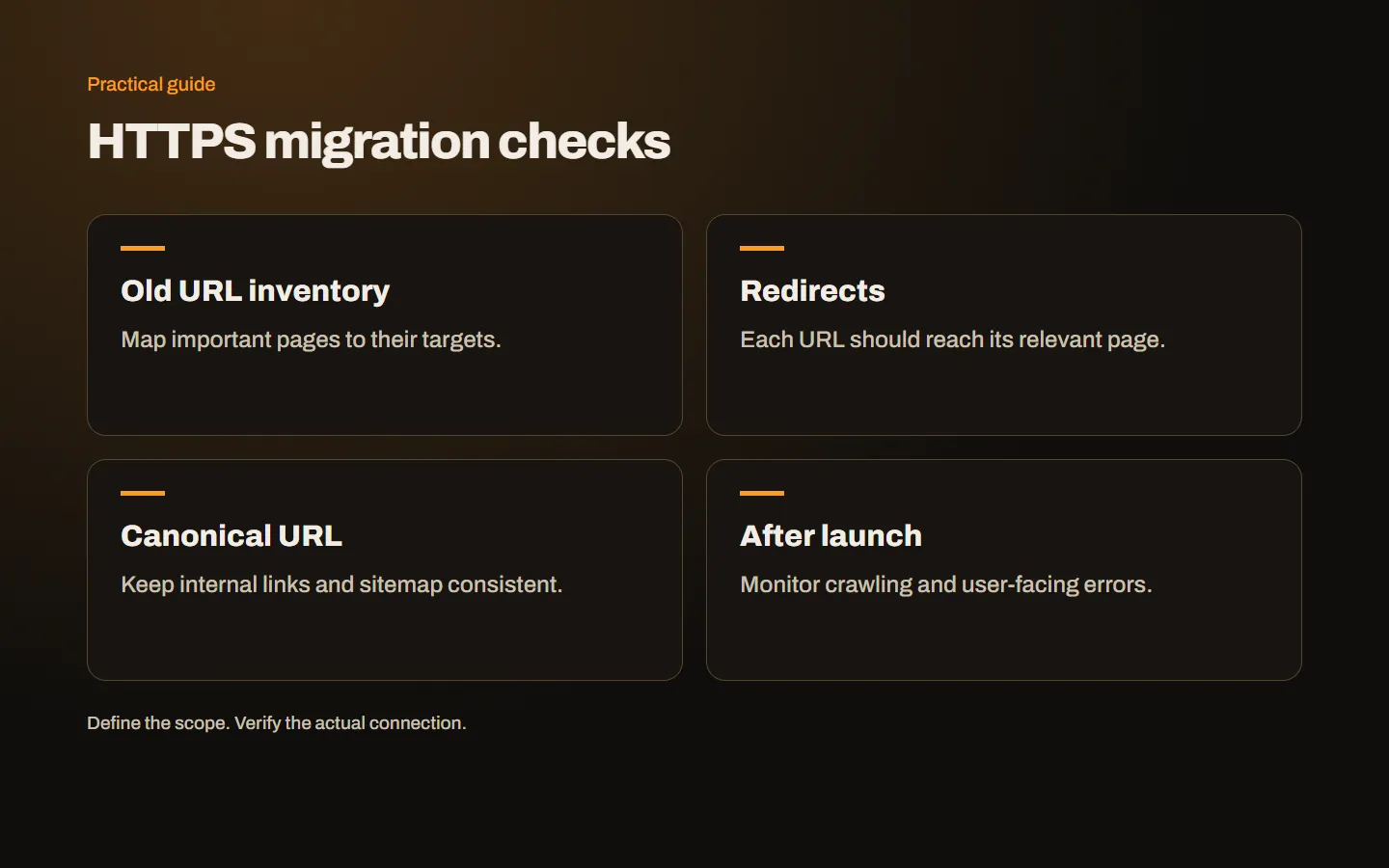
Inventory existing pages, including products, categories, articles and important files. Map each relevant old URL to its intended destination. Combining protocol migration with major path and design changes can complicate diagnosis, so keep a clear mapping if multiple changes are necessary. The technical team should be able to explain where a particular old link will end up before launch.
Redirect to the relevant page
An old product URL should reach the corresponding product, not send every visitor to the home page. Use suitable permanent redirects for a permanent move and preserve required path and query behavior. Domain, www and protocol preferences should be coordinated so that different layers do not create unnecessary chains or loops.
For example, an HTTP www address might first go to HTTPS www, then to the apex and then to a new product path. Review whether that can be simplified without losing application requirements. Inspect response codes and final destinations rather than relying on a single successful browser visit. Test several initial address variants because users and crawlers can arrive through older links.
Align canonical and discovery signals
An HTTPS page declaring an HTTP canonical creates inconsistency. Internal navigation, content links and sitemaps should reference the intended secure addresses. On multilingual sites, review hreflang counterparts too. Structured data can also contain page and image URLs that need the same consistency check.
Updating the shared template may not fix addresses embedded in old content records. Articles and product descriptions may contain absolute HTTP links from years earlier. Crawl the site or use an appropriate inventory to find repeated sources. Each page should have an understandable canonical destination, and the sitemap should contain direct working URLs rather than redirected or failing entries.
Verify certificate coverage for entry addresses
The HTTPS transition is incomplete if an entry hostname produces a certificate warning. The apex, www and relevant subdomains need matching coverage. An HTTPS www alias still requires a valid certificate before it can redirect to the apex. The browser cannot bypass the initial TLS check simply because the destination is another secure URL.
Use our selection guide to review the scope. If a CDN and origin use different certificates, check both required connections. Renewal failures can interrupt visitor access and crawling continuity. This is why certificate maintenance should be visible to the people managing the website’s overall performance, with an identified technical owner rather than only an accounting renewal reminder.
Fix mixed resources as part of migration
A secure main document can still call HTTP images, styles or scripts. Browsers may upgrade some requests and block others, potentially leaving pages incomplete or forms unusable. Treat this as a functional publishing problem rather than merely a report label. Important actions need to work after the transition.
Combine browser diagnostics with site-wide checking. Review old articles, campaign components and external embeds. Changing the protocol text does not help if the resource lacks valid HTTPS support. Our mixed content guide explains how to locate the generating source and retest the action. Do not accept a clean home page as proof that every archived article and checkout component is correct.
Monitor the right Search Console scope
Understand whether you are viewing a domain property or a specific URL-prefix property. They do not represent the same scope. Submit a sitemap containing the intended secure URLs and inspect important example pages. Interface labels can change, so read the actual report context rather than depending on a memorized menu path.
Avoid drawing conclusions from a single day’s impressions. Crawling and indexing updates vary by site and URL. Google’s URL-change migration guide includes protocol changes in its migration framework. Review old and new URL behavior together with errors and indexing observations, and do not promise a fixed recovery date or interpret every fluctuation as proof of a certificate problem.
Plan HSTS after the foundation works
HSTS tells browsers to use HTTPS for a defined period. It is not a switch that repairs an invalid certificate or a broken redirect. Verify the required services first, especially before applying a policy to subdomains. Forgotten services can otherwise become harder for visitors to access.
Decide policy duration and scope with the infrastructure team. Do not enable preload casually without understanding its requirements and reversal implications. MDN’s HSTS documentation explains the browser behavior. The migration priority is accessible, consistent secure URLs; additional persistent policies should build on a tested foundation rather than hide incomplete preparation.
Do certificate classes create special ranking gains?
Choose DV, OV and Wildcard arrangements for validation and coverage needs rather than treating them as SEO packages. Organization validation cannot fix an irrelevant redirect. Broader hostname coverage does not improve weak content. If several changes occur together, keep a change log instead of attributing all later traffic movement to the certificate purchase.
When particular pages disappear or fail after migration, inspect concrete old and new URL pairs first. Check the response, redirect and canonical before making broad site changes. Retain useful redirects because old links can remain in email, external sites and search results. Our SEO measurement guide helps frame the wider review. Explore our SEO and advertising service or contact us with your migration inventory.