
Customer portals, APIs and support systems often use separate subdomains as a website grows. A Wildcard certificate can simplify certificate coverage for some of these services. Its star notation has specific limits, however, and it does not automatically secure every domain, every depth of subdomain or every server operated by the same business.
What the star matches
The pattern *.example.com matches a single label immediately below example.com. Names such as shop.example.com, panel.example.com and api.example.com fit that pattern. api.eu.example.com does not, because it introduces another level. The star should not be understood as a permission covering everything anywhere below a domain.
The apex example.com is not itself matched by *.example.com. A product may include the apex separately, but inspect the actual alternative names in the certificate. example.net is another registered domain and also requires its own coverage. Common ownership does not change hostname matching. These distinctions explain why some addresses can work while others display warnings after the same purchase.
An example coverage table
The table assumes that the certificate contains only *.example.com. Additional names in a real certificate can change the result. Replace these examples with the exact hostnames used by your services before ordering, especially for regional applications or nested administrative portals.
| Hostname | Matches this pattern? | Deployment note |
|---|---|---|
| www.example.com | Yes | Immediate subdomain |
| panel.example.com | Yes | Still needs installation |
| example.com | No | Add the apex separately |
| api.eu.example.com | No | A deeper hostname |
| example.net | No | Another registered domain |
A redirect does not remove the coverage requirement. The browser establishes TLS before receiving an HTTP redirect, so an HTTPS alias must present a valid certificate even if its only job is sending visitors elsewhere. Include entry addresses and old campaign links in the inventory as well as the main public destination.
Where Wildcard can simplify management
Wildcard coverage can be useful when a central team frequently creates same-level subdomains. A portal, API and staging service may fit a coordinated deployment process. A newly created matching name may not require adding a new name to the certificate, but DNS, service configuration and deployment still need attention.
For example, a centrally managed portal and support application may share a documented certificate distribution process. In contrast, independently hosted services may each have their own automatic certificate management. Moving those into a shared certificate arrangement can introduce unnecessary key distribution. Understand each platform’s capabilities before assuming that one certificate is always simpler than several independently managed ones.
Coverage is not encryption strength
Wildcard is not a stronger form of encryption. It describes hostname matching. Products may combine the appropriate coverage with DV or, where supported, OV validation. Asking whether to buy DV or Wildcard therefore mixes two decisions: identity validation and hostname scope.
Connection security still depends on appropriate TLS configuration and key handling. A certificate covering many names does not update software or separate application permissions. Nor should Wildcard be chosen to obtain search ranking benefits or a special browser indicator. The certificate selection guide explains how to assess the operational requirement instead of treating product labels as security grades.
DNS validation and automation
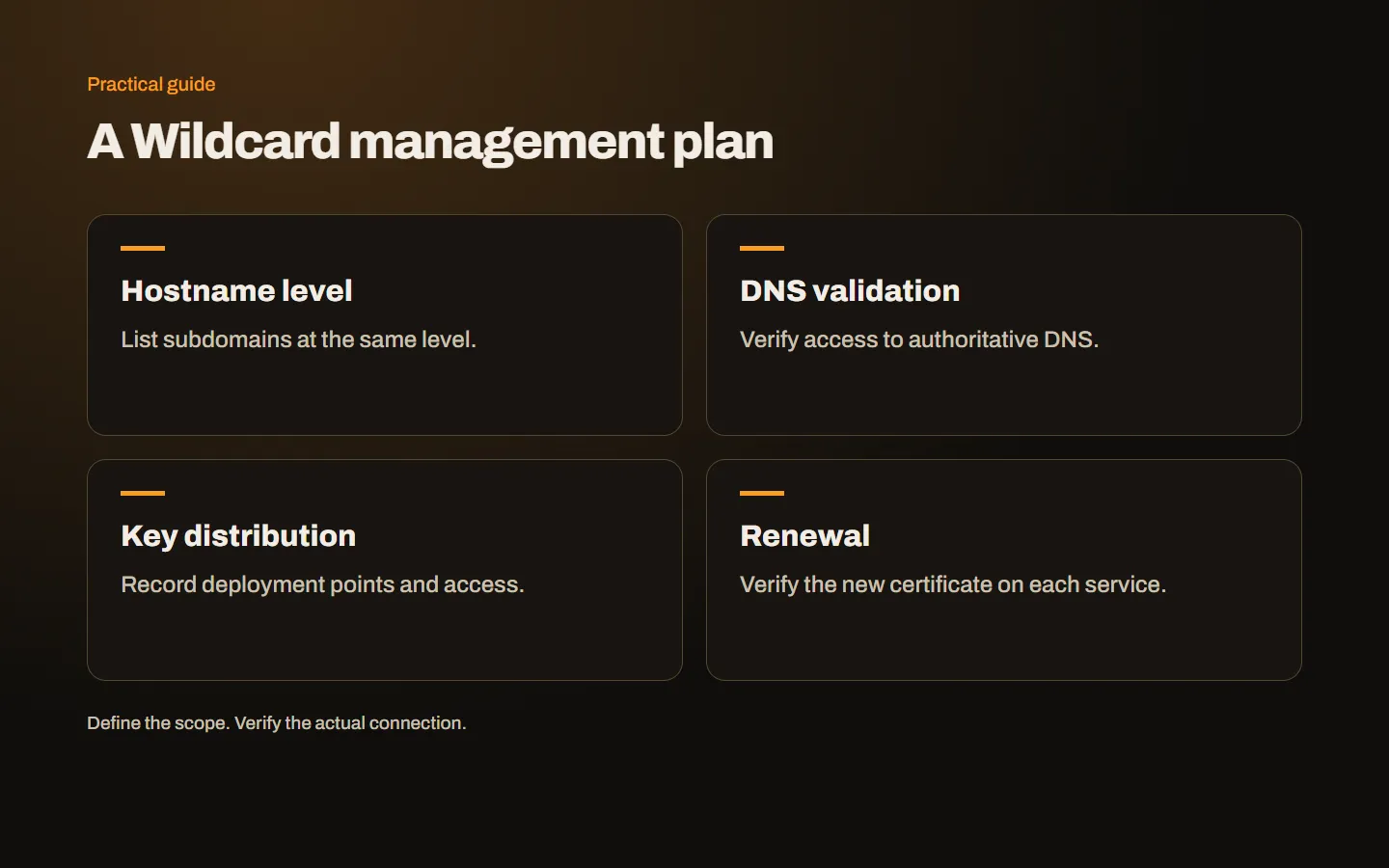
ACME Wildcard issuance uses DNS-based validation. A specified value is published in the authoritative DNS zone to demonstrate control. The Let’s Encrypt challenge documentation explains the DNS-01 method and its Wildcard support. Your domain registrar, DNS provider and web host may be different organizations.
Establish where authoritative records are managed before ordering. A record added to an inactive hosting DNS zone will not complete public validation. If automation requires API credentials, use appropriately limited permissions and protect those credentials. Changes to the DNS provider, account or API access can interrupt renewal. Record the owner of this dependency without exposing secret values in the certificate inventory.
The impact of sharing a private key
When the same certificate and private key are installed on many servers, a key exposure can affect a wider set of services. Replacing the key requires reviewing all relevant deployment points. This is an operational trade-off, not a reason to reject Wildcard universally. Centralized convenience should be assessed alongside the consequences of shared credentials.
Separate teams or security boundaries may justify separate certificates. Document where keys are held, who can access them and how replacement reaches each service. Do not put private keys in public web directories or ordinary chat messages. A clear inventory is particularly valuable during incident response, when missing one forgotten server can leave part of the previous configuration active.
Installation is still service-specific
A Wildcard certificate installed on a web server is not automatically installed on a mail server elsewhere. Each service has its own TLS configuration and possibly different file requirements. Matching the hostname solves one part of the problem; it does not complete deployment or prove that the application works.
A CDN or reverse proxy can introduce separate visitor-facing and origin certificates. Verify both relevant connections. Opening the home page externally does not prove that every backend or alternate endpoint received the new certificate. Map services to deployment points and owners. Use our installation checklist to make this acceptance process explicit rather than relying on the certificate order status.
Renewal includes distribution
Issuing a replacement certificate is not the end of renewal. The new certificate must reach every required endpoint, and each service must actually present it. One control panel can show a new expiry while another server continues using an old file. External checks help detect that mismatch.
Ask the technical team to document validation access, deployment steps and alert handling. Test the alert route rather than assuming that notices reach the right person. Our renewal guide separates payment, issuance, distribution and verification. When adding a subdomain, include it in monitoring and deployment records even when the existing Wildcard pattern already matches its name.
Accepting a newly created subdomain
For a new reports.example.com service, identify the DNS destination and service owner first. Confirm matching certificate coverage, configure the service and test the actual external connection. Then try important actions such as sign-in and report download. Finally, add the endpoint to ongoing monitoring. Creating the DNS record alone does not complete this workflow.
If the service sits within a different security boundary, assess whether it should use a separate key. A Wildcard purchase does not oblige you to share its key everywhere. Similarly, deleting a DNS record does not automatically revoke the certificate. When retiring a service, review accounts, old servers and key copies as separate tasks, especially if another supplier previously operated it.
Make the purchase decision from the inventory
List same-level names, the apex and deeper services separately. Compare their existing management arrangements and the impact of shared keys. Wildcard is useful when it simplifies a well-defined operational process. Explore our Wildcard SSL options, read the OV guide if identity validation is needed, and contact us with the service inventory for a scope review.