
A secure connection and a verified organization identity are related but distinct requirements. Organization Validation, or OV, adds checks on the organization behind a certificate. Understanding that role helps a business prepare the right information, allow time for validation and avoid expecting a certificate to solve unrelated application security problems.
What organization validation covers
OV combines domain control validation with checks on the organization named in the application. The issued certificate contains verified organization information. This does not mean the authority has approved every statement on the website or guaranteed future business conduct. The certificate’s function should be described precisely rather than treated as a general endorsement.
DigiCert’s OV documentation outlines the identity and domain checks involved. Evidence and contact procedures depend on the authority’s current rules. Request the requirements for the actual application instead of copying an old checklist from another supplier and assuming that every document or verification period remains identical.
How OV differs from DV
The principal distinction is the information validated before issuance. DV establishes domain control; OV adds organization identity validation. Under otherwise equivalent technical conditions, OV should not be described as inherently stronger encryption. TLS configuration and key management remain separate aspects of the connection.
For example, a hostname mismatch will not disappear merely because the replacement product is OV. An outdated plugin remains outdated, and a weak administrator password remains weak. If a current DV installation works correctly, justify the move through an identity requirement or documented business policy. Our DV guide explains where domain validation alone may be suitable.
Projects that may need OV
A partner portal, business application or corporate website may need verified organization details in its certificate. The requirement may come from a customer specification, procurement policy or the operator’s own identity needs. Traffic volume and visual design are not, by themselves, reasons that make OV mandatory.
For example, a distributor portal may have a contractual organization validation requirement. Include validation in its launch schedule rather than treating it as an instant final step. A smaller presentation website without that requirement may reasonably use DV. Avoid universal claims that every business site must use OV or that only large organizations can apply. Assess eligibility and the actual project requirements.
What visitors will see
Do not promise that the company name will always appear prominently beside the address. Browser interfaces and access to certificate information vary. OV provides verified organization details within the certificate; that is different from a graphic trust seal placed on the website. If a seal is included, understand what its verification link actually demonstrates.
Claims about a special green address bar, automatic sales increases or guaranteed search improvements should be questioned. Clear contact details, delivery information and support remain important parts of customer confidence. A certificate cannot replace those explanations. Present identity validation as one specific feature of a broader trustworthy service, with no invented performance claims attached to it.
Prepare the organization information
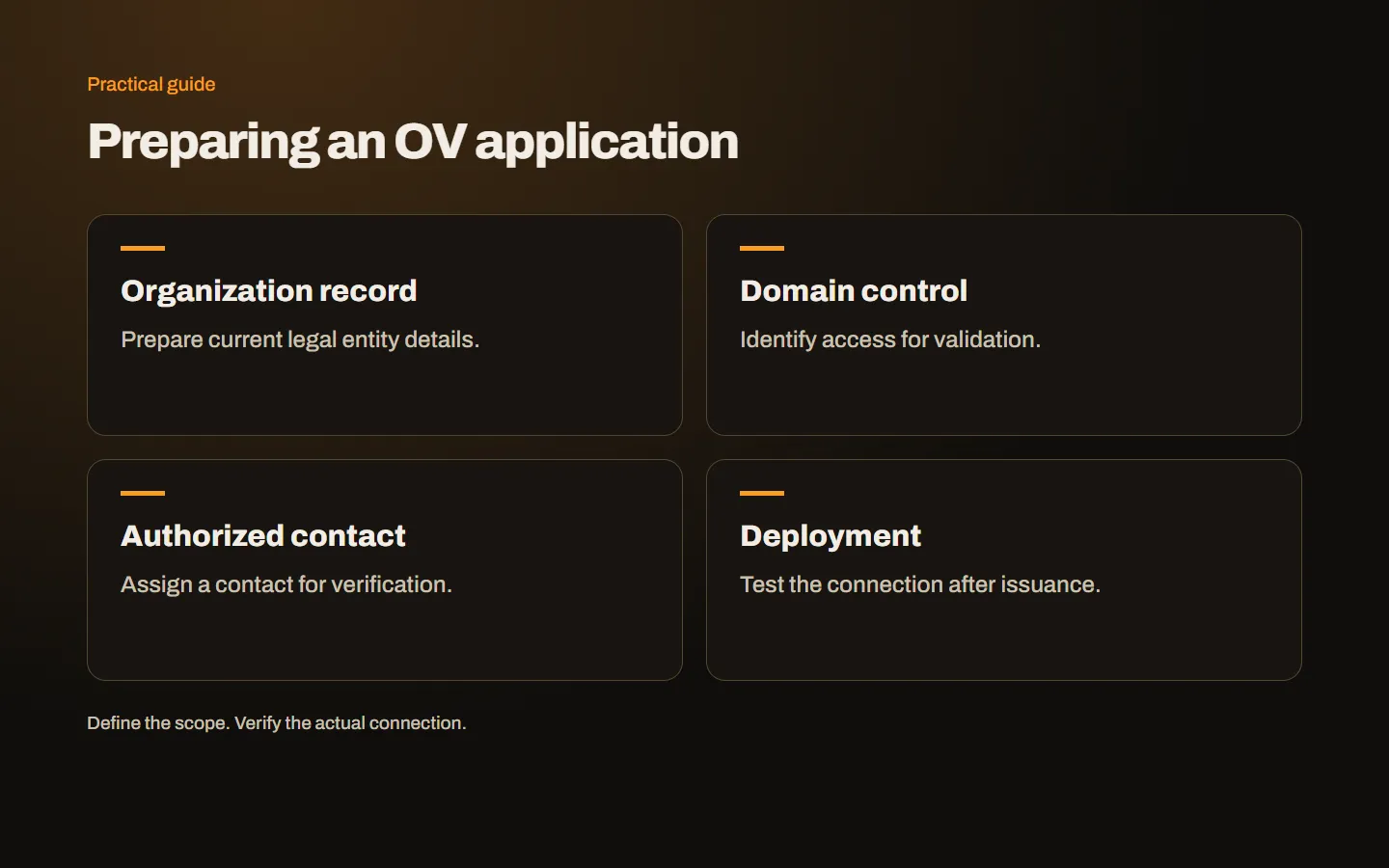
Check the legal name and current registration details. A trading brand can differ from the legal entity, so decide which organization is applying. If the domain is managed by another company or account, clarify authorization before starting. Organization documents alone do not prove control of the requested domain.
Assign an authorized contact and a separate technical deployment owner if needed. Inconsistent information can require follow-up, so allow time for questions. Do not assume a fixed issuance time for every case. The authority completing validation and the technical team installing the certificate are different milestones; the website is not ready merely because the first has been completed.
Identity class and hostname coverage
OV describes validation. Wildcard and multi-domain describe coverage patterns available in relevant products. Confirm the exact hostnames in the order and in the issued certificate. Seeing OV in a product name does not mean that the apex, www, customer portal and every future service are all included.
example.com, www.example.com and portal.example.com are distinct names. A separate registered domain also needs suitable coverage. Our Wildcard explanation shows why a star pattern does not cover arbitrary deeper levels. Creating an accurate hostname inventory before ordering can reduce later reissuance work. Check the supplier’s additional-name and reissuance terms as part of the service comparison.
Keys, requests and installation
The private key, certificate signing request and issued certificate serve different roles. Keep the private key secret and out of ordinary support messages or public storage. A management platform may handle key generation internally, so exporting files is not always necessary. Ask which steps are managed and which require your team’s involvement.
Organization approval does not deploy the certificate automatically. Web servers, proxies and other endpoints must present the intended certificate. The key must match, and the chain must be correctly configured. Use the installation checklist to verify redirects, browser behavior and important forms after installation. Acceptance should reflect the visitor’s experience as well as the supplier’s order status.
Keep identity information current
Review the legal name, address and authorized contacts before renewal. Previous validation does not imply that no further checks will be required. Reuse rules and authority procedures can change. Rely on current instructions and the actual deployed certificate’s expiry rather than assuming that last year’s schedule applies unchanged.
Route notices to an accessible business channel with a backup owner. A former employee’s mailbox should not be the only way to receive verification requests. Payment, issuance and deployment are separate events. The renewal guide explains how to track each one and confirm the certificate visitors actually receive.
Brand and legal entity need a clear relationship
A public brand may be operated by a differently named legal entity. Enter verifiable organization information rather than marketing copy in the application. Within a group of companies, establish which entity operates the site and who is authorized to request the certificate. The commercial contact does not have to be the server administrator.
For instance, an agency may manage deployment while the client confirms organization details. If this division is not recorded, an application can appear technically delayed when it is waiting for identity evidence. Track the open step and its owner. Share requested documents through the authority’s suitable channel, avoiding unnecessary distribution. If the entity changes later, ask whether reissuance or a new application is required.
Compare the service, not just the label
Ask which entity is validated, which hostnames are covered and where installation is included. Confirm support, reissuance, migration and renewal responsibilities. These details reveal the practical difference between similar product names. Explore our OV SSL options and web design service, or contact us with your identity requirement and hostname inventory so that the certificate and launch plan can be assessed together.