
Choosing an SSL certificate is easier when you start with the actual services rather than a list of product names. Identify the hostnames, deployment points and maintenance owners first. Then separate identity validation, hostname coverage and the support service being purchased. This approach reduces both unnecessary purchases and incomplete installations.
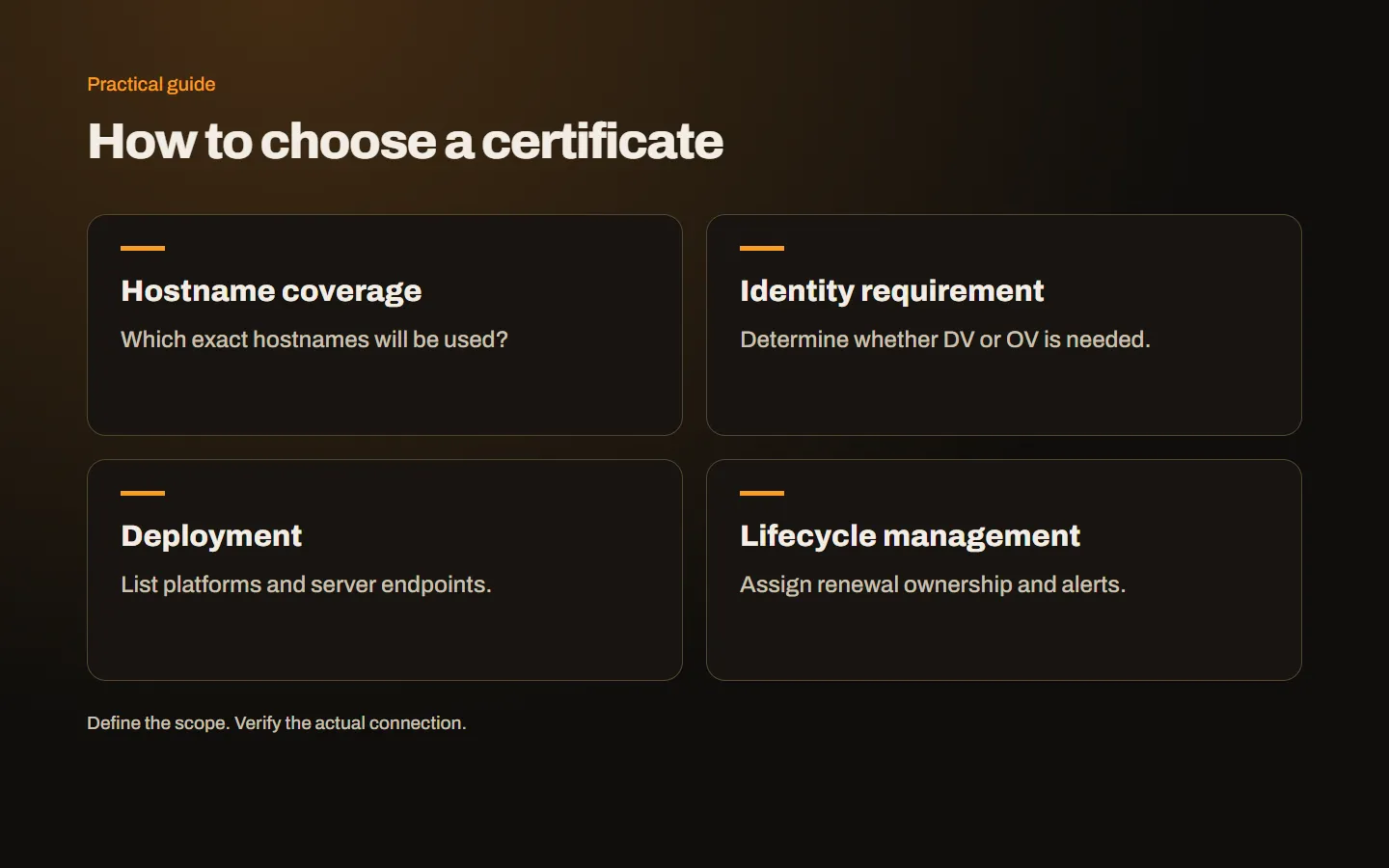
Build a hostname inventory
List the main site, www alias, store, customer portal and API endpoints. Record who operates each one and where the connection terminates. Services under one parent domain may run on different platforms. A certificate displayed in one hosting panel does not demonstrate that a separate customer application has also been configured correctly.
Include old campaign entry addresses and recently migrated services. Every address that accepts HTTPS must present suitable coverage before it can redirect elsewhere. Make this inventory understandable to the business owner as well as the developer. It becomes the starting point for quotations, installation acceptance and future maintenance rather than a temporary technical note that disappears after launch.
Separate validation from coverage
DV describes domain control validation. OV adds organization identity checks. Wildcard describes a hostname pattern. These labels are not mutually exclusive small, medium and large security packages. A certificate decision needs an answer to both what will be validated and which names will be covered.
A presentation website without a separate identity requirement may use DV. A project requiring verified organization details can consider OV. Several same-level subdomains may justify Wildcard coverage. The exact product and authority determine available combinations. Ask for the intended validation class and hostname list in writing so that a familiar label does not conceal an incorrect technical scope.
Match the address structure
A single-name product covers its specified hostname, subject to any additional names included by the supplier. Multi-domain certificates contain a list of alternative names. Wildcard patterns match the relevant immediate subdomain level. For example, *.example.com matches panel.example.com but does not match api.eu.example.com.
The apex example.com also needs explicit coverage rather than being assumed to match the star. Confirm these details in the issued certificate, not only on the order form. Our Wildcard guide includes a comparison table. Unlimited matching subdomains should not be interpreted as unlimited depth, unlimited servers or unlimited installation assistance; those are separate technical or service conditions.
Review the current arrangement
Managed hosting or an application platform may already provide automatic certificates. Before buying another product, check whether that arrangement covers the intended names and whether renewal is monitored. A functioning trusted installation does not need replacing solely because it is free or because another product has a more elaborate marketing description.
For example, the public site and API might each use their platform’s automatic certificates. That can be entirely appropriate. Combining them into one certificate is worthwhile only if it improves management without creating unnecessary key sharing. Describe the actual gap first: missing coverage, required identity validation, unavailable support or unreliable renewal. The solution should address that specific gap.
Establish the identity requirement
OV is relevant when verified organization information is needed within the certificate. This can come from a partner specification, internal policy or another documented business requirement. High traffic or an expensive product catalog does not independently create a universal OV obligation. Read the actual requirements rather than inferring them from the website’s appearance.
Do not expect organization validation to provide inherently stronger encryption, automatic sales growth or special search ranking. Allow time for correct organization details and authorized contacts. Approval and technical installation are separate milestones. The OV guide explains preparation and the limitations of identity validation so that the project schedule reflects the real process.
Compare the managed service
Two offers can contain similar certificates while including very different work. One may only issue the document; another may include installation, redirect checks and renewal monitoring. Ask which tasks the supplier owns and which access you must provide. Price comparisons are meaningful only when the delivery scope is clear.
Confirm the deployment points, tested services, renewal alert route and migration arrangements. Ask about reissuance and additional-name terms. Establish who holds the private key and how access is protected. Commercial warranty language should be read with its conditions rather than assumed to provide general compensation for any website problem. A precise service description is more useful than an unlimited promise of security.
Consider the full connection path
A CDN or reverse proxy can create two separate connections: visitor to edge and edge to origin. Seeing HTTPS in the browser does not independently verify the origin connection. Ask the infrastructure team to explain where TLS terminates and how identity and encryption are configured on each relevant leg.
For Cloudflare, the Full strict documentation describes origin certificate validation. Other providers use their own terminology. Understand the path rather than copying a setting name without context. When moving platforms, changing DNS alone does not guarantee that the previous certificate arrangement continues working in the new environment.
Discuss renewal before ordering
A certificate is an ongoing service dependency. Its actual validity period can differ from the paid service term, so a long-term package may involve multiple issuances. Confirm how automation, deployment and external monitoring work. The operative expiry is the one presented by the service, not simply a purchase anniversary in the accounts system.
If DNS validation is required, plan for persistent appropriate access. API credential rotation or a team change can interrupt automation. Purchasing and technical owners need a shared understanding. Our renewal guide separates the commercial, issuance, distribution and verification stages. Agreeing this before purchase makes later handovers less dependent on one person’s memory.
Test the choice against realistic examples
A simple site with no organization requirement may only need verification of its existing automatic DV setup. Several independent brand domains may suit separate certificates or an appropriate multi-domain product. Frequently created subdomains operated by one team may benefit from Wildcard coverage. These are examples to test against the actual hosting and access arrangements, not universal rules.
Write the decision in a short note: covered hostnames, validation class, deployment points and renewal owner. Include what happens when hosting changes. Some platform-managed certificates are replaced by new issuance on the destination platform rather than exported as files. Knowing that in advance helps coordinate DNS, validation and redirects during migration.
Move from selection to acceptance
After selection, use the installation checklist to test real forms, accounts and payment returns where applicable. Keep dates, addresses and results in the handover, with no private keys or passwords. Compare our SSL certificate options, explore our web design service, or contact us with the current inventory to align coverage, validation and maintenance.