
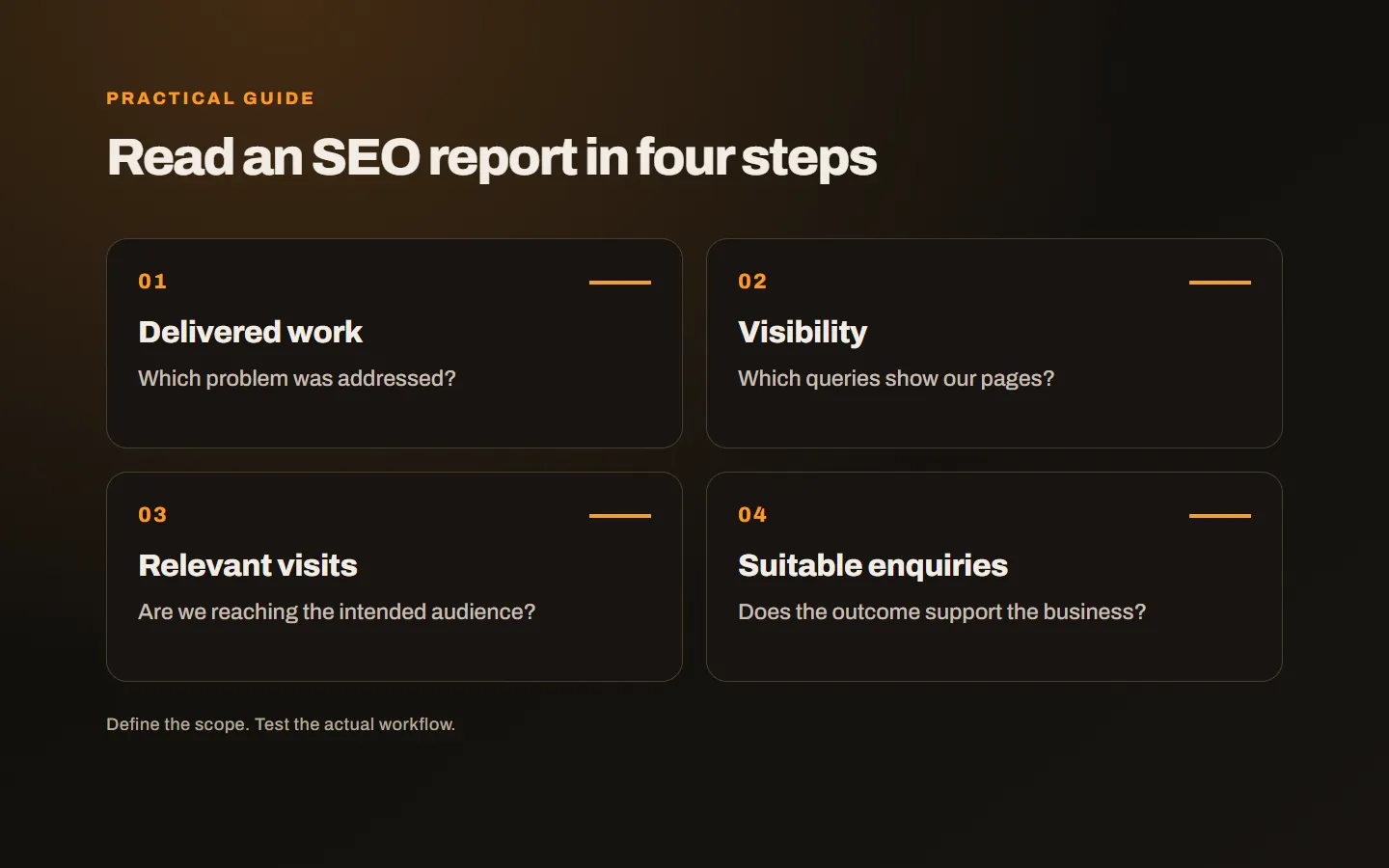
A rising chart is encouraging, but it only becomes useful when you know what it represents. Visibility, relevant visits and suitable enquiries are different stages. Reading an SEO report through those stages helps reveal what is improving and what still needs attention.
Define the business purpose first
A service business may want qualified project enquiries. An online store may focus on product discovery and orders. An information website may need to answer a defined set of questions. A single success table cannot fit every case.
Agree on target services, customer types and locations. Replace a broad request for more traffic with the pages and needs that matter to the business. A highly visited article with little connection to your offer cannot be the only measure of success.
A useful objective might be: people who do not yet know the brand should discover relevant services and be able to make a suitable enquiry. That makes clear why total visits alone are insufficient.
Separate delivered work from its effects
Publishing pages, correcting links and improving titles are activities. Their effects on visibility, usage and enquiries are outcomes. A useful report includes both: a task list does not show impact, and a graph does not explain what changed.
For significant work, ask what the issue was, what was changed and what happened afterwards. If a service page was clarified, look at relevant query groups and the suitability of incoming enquiries.
Technical repairs deserve their own explanation. Removing an accidental indexing restriction is a different task from creating an article. Combining them into one keyword count makes the delivery harder to assess.
Read each stage separately
Search impressions are not clicks, and clicks are not enquiries. An improvement in one stage does not guarantee the next. Use changes to frame questions rather than assume a single cause.
| Observation | Question to investigate |
|---|---|
| More impressions, steady clicks | Are the new queries relevant and the page promise clear? |
| More clicks, steady suitable enquiries | Does the page meet expectations and explain the offer? |
| Enquiries without sales | Are the leads suitable and how are they followed up? |
| More branded searches | Could other promotion be contributing? |
Pricing, seasonality, campaigns and product availability can affect the same outcomes. Record those factors alongside the search work.
Distinguish brand discovery from brand demand
Someone searching your company name already has a different relationship with you from someone discovering a service through a problem. Both matter, but growth in branded searches should not automatically be credited to new content.
Also avoid treating every article as one uniform group. A reader researching domains is at a different decision stage from a visitor comparing custom software approaches. Review topics alongside the services they support.
Compare equivalent periods
Use comparable durations and consider seasonality. Note redesigns, URL changes and changes in measurement definitions. Comparing different seasons without context can exaggerate either progress or decline.
Show actual counts alongside percentages, especially when enquiries are infrequent. Small numbers can produce dramatic percentage changes. Review the trend and quality of enquiries rather than treating a few days as proof. A confirmed technical fault can still be fixed immediately; careful interpretation does not mean delaying repairs.
Set realistic expectations about time
Starting conditions, competition, demand and content all differ between sites. Google’s SEO Starter Guide explains that changes can take different amounts of time to show effects and that indexing is not guaranteed.
That uncertainty does not remove the need for a delivery plan. Early work, target pages and indicators can still be specified. A request for patience should be accompanied by concrete actions and observations.
Evaluate the method rather than a promise of an exact ranking on an exact date. Ask which assumption is being tested and what the next decision will be if the expected change does not appear.
Keep a simple change log beside the reporting periods. It makes later comparisons easier when content, measurement definitions or the website itself have changed.
Ask five questions in each reporting period
- Which specific problems were addressed?
- Which pages and query groups changed?
- Are the visits relevant to the intended customers?
- How are suitable enquiries recorded?
- What is the next priority and which observation supports it?
Make sure a contact-button click is not silently treated as a confirmed enquiry. Some telephone and message activity may remain difficult to attribute; understand that limitation. For local discovery, our Google Business Profile guide provides additional context.
Our SEO and Google Ads service considers visibility alongside service pages and contact journeys. Share your current report and the services you want to attract enquiries for, and we can identify the information that will support your decisions.