
Businesses often begin domain selection with a name and an introductory price. Account access, renewal responsibility and email arrangements deserve the same attention. Checking these details before registration can prevent confusion when your provider or agency changes.
1. Say the name aloud
A short domain is not always easy to communicate. Similar-sounding letters, repeated numbers and hyphens can cause mistakes. Tell someone the address without spelling it out and see what they type.
Consistency with your business name helps across email, printed material and conversations. Avoid squeezing every service keyword into the address. A narrow name can become awkward when the business expands.
Review common alternative spellings, but do not assume you must buy every extension and variation. Balance protection against actual confusion and the ongoing renewal budget.
2. Choose an extension for its use
Consider audience expectations, ease of communication and registration conditions. A clear alternative can be more usable than a short name made difficult to read simply because it was available.
Extensions do not all have identical eligibility and registration rules. Check the current requirements with the relevant registry or registrar, especially for country-code domains.
Do not rely on an extension alone for search visibility. Google’s SEO Starter Guide explains that extensions do not provide a general ranking shortcut, while some country-code extensions can indicate geographic targeting. Make the business and audience fit the main consideration.
3. Keep account control with the business
An agency can register and manage a domain without leaving the business unclear about access and registrant information. Know the registrar, the account owner and the authorised contacts.
An employee’s personal account can create a similar dependency. Recovery messages and verification access should not vanish when a person leaves. Include domain administration in the business’s access and handover procedures.
Record these essentials:
- Registrar and responsible account administrator.
- Renewal date and recipients of reminders.
- Account recovery and two-factor authentication arrangements.
- The location of DNS management.
- Hosting and email providers.
4. Read renewal terms, not only the offer
The first-year price may not represent future costs. Review renewal, transfer and optional service charges, including currency and taxes. Some names or extensions can have different pricing arrangements.
If automatic renewal is enabled, keep the payment method current. Assign someone to check reminders rather than relying on an unowned calendar entry.
Do not assume an expired domain can always be recovered at the same price. The available process depends on the extension and the stage reached. Renewing before the deadline is simpler than relying on a recovery route.
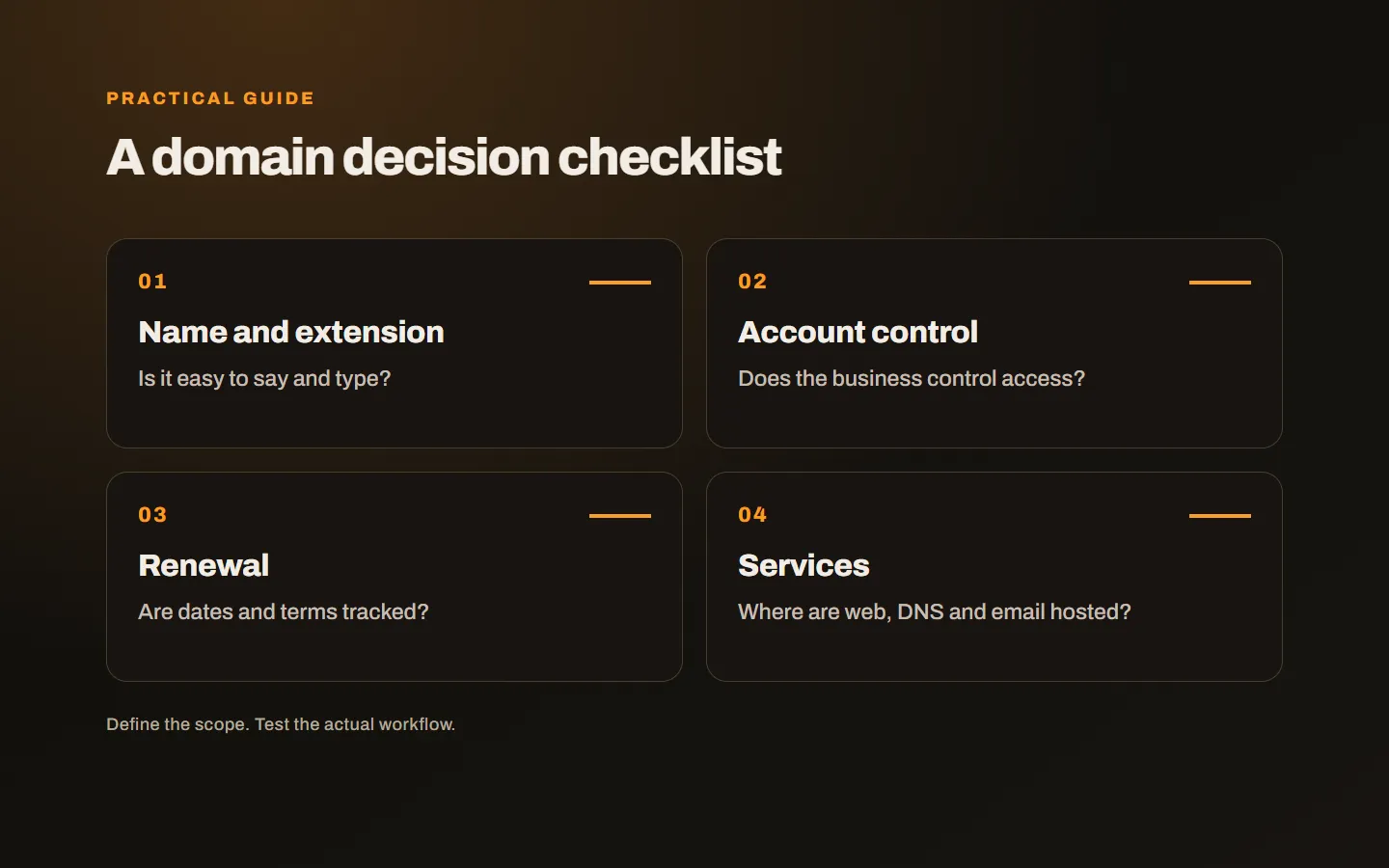
5. Separate domain, hosting and email
The domain is the address people use. Hosting runs the website, while email can be supplied independently under the same domain. Moving one does not automatically move the others.
DNS records connect those services to their destinations. You do not need to memorise every record type, but keep an inventory of where each service lives. A working website with failing mail points to a different part of the setup than a missing site.
When launching a new website, preserve existing email records if mail is staying with its current provider. Replacing a DNS zone without reviewing its contents can fix the website while interrupting email.
If messages fail to arrive or reach spam, our business email diagnosis guide helps distinguish sending sources from domain configuration.
6. Test international characters in real use
Internationalised domain names can be registered, but consider where you will share the address. Messaging applications, printed material, email systems and other software may display or handle it differently.
Try the proposed address in the tools you actually use. Say it aloud, send it in a message and check the resulting display. Our guide to Turkish-character domain names explains the technical background and practical considerations.
7. Investigate previous use
For a previously registered name, review visible history, links and possible brand confusion. Its old use may have no connection with your business. A memorable name is not enough reason to skip that research.
Availability is also different from permission to use a name commercially. If it could conflict with another brand, obtain an appropriate assessment before committing to branding and development.
Store the service inventory where another authorised colleague can find it. A technically correct setup can still be difficult to manage when only one person knows where the accounts and renewal notices are held.
8. Consider a future provider change
If you move registrars later, account access and authorisation become important. ICANN’s transfer FAQ explains authorisation codes and transfer restrictions for the domains within its scope. Check the rules applicable to your extension and registration status.
Our hosting and infrastructure service considers domain, website and mail dependencies together. Tell us about the name you are choosing or the access you are unsure of, and we can begin with a clear service and account inventory.