
If an advertising report shows more enquiries while sales conversations stall, inspect what those enquiries contain. Requests outside your scope, misunderstood budgets and information-only messages can all appear in the same total. Review the journey from advertisement to first response before deciding what to change.
Agree on what a suitable enquiry means
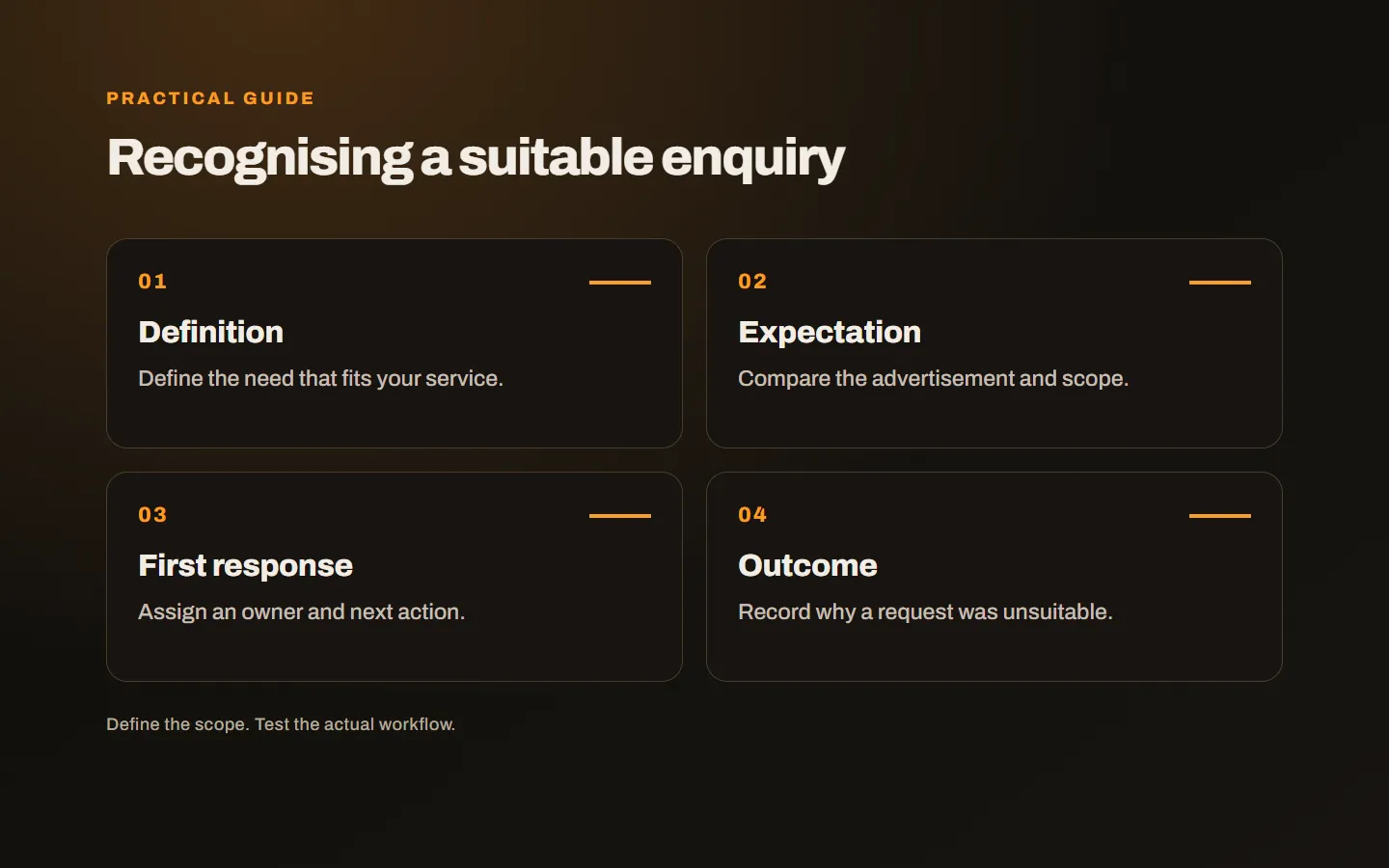
The sales team and campaign manager may classify the same contact differently. One might count every form, while another considers only requests ready for a proposal. Establish which stage you are discussing so the report does not become an argument between incompatible totals.
Describe suitability through your service. Is the need relevant, is the contact reachable and is the person open to evaluating a project? Not every job needs identical questions. A small maintenance request should not be judged against the same scope expectations as a substantial custom application.
A complicated scoring system is not essential at first. Understandable states such as suitable, outside scope, unreachable and future consideration can provide a starting point. Define how staff use those states. If each person interprets them differently, later comparisons become unreliable.
Record why requests are unsuitable
Writing “poor lead” does not identify a fix. Was the person expecting another service, free support or a different working arrangement? Separate the reasons so the next advertisement or page change has a basis.
A short note can be enough: an existing product password request, for example, is different from someone expecting a ready-made package. Being unable to reach someone is also different from a service mismatch. Do not automatically attribute every unresolved conversation to the audience settings.
Collect information relevant to assessing the work, without unnecessary personal detail. The objective is to understand the expectation that failed, not to create an extensive profile of the individual. Consistent short records are more useful than scattered impressions across team conversations.
Inspect the expectation created by the advertisement
Compare advertisement wording with messages from prospective customers. Broad promises, urgency or references to free services may be shaping the contacts you receive. Words that imply a working method you do not offer can increase activity while reducing its relevance.
For example, custom development advertised as if it were an instant ready-made site requires the sales team to reset expectations. The solution is to improve the information, rather than blame the customer for misunderstanding. The advertisement and destination should describe the same service.
For search campaigns, review available search terms regularly. Identify repeated mismatches before changing the account. One unsuitable enquiry does not establish that an entire group of searches is unhelpful. Combine the available account evidence with the actual conversations.
Explain service boundaries on the page
Visitors should be able to recognise who the service suits and which jobs need separate discussion. Hiding boundaries may produce more forms, but leaves the team correcting the same expectation repeatedly. Clear information respects both the prospect’s time and your own.
Where prices depend on a project, explain what changes the scope. Integrations, migration and different user roles may matter. Instead of only asking people to call for a price, explain which details the discussion needs to establish. This offers a useful framework without pretending every project has one fixed cost.
Ask useful questions at the right stage
A service selection and brief description may help the first assessment. A long screening questionnaire can also discourage suitable customers. Distinguish information required before a conversation from details that can be established during it. Evaluate additional questions through actual submissions.
Use language the customer understands. Rather than requiring an answer about APIs, ask which systems need to share information. Let people explain their problem in their own terms before asking them to select technical solutions.
Do not remove every useful question simply to make the form shorter. The goal is a manageable first step that supplies enough context for a meaningful reply. Explain why a particular detail is required when its purpose may be unclear.
Include response and proposal handling
A suitable person may already have contacted you while the request sits in an unowned inbox. Define who replies, what they review beforehand and how the next step is recorded. Several people receiving a notification does not establish responsibility.
The first response need not always be a price document. A short question or discussion may be necessary to understand the scope. Explain why, and read the information already supplied rather than asking the person to repeat everything.
Use a reasonable, defined process for unreachable contacts. Record the status and an appropriate next action instead of leaving them open indefinitely. This makes outstanding requests understandable in the report as well as in daily work.
Share outcomes with the people evaluating advertising. Without reasons for unsuitable enquiries, the account may continue to be judged only by form totals. A shared record with consistent definitions can establish that feedback loop without requiring another software purchase.
Observe a clear change before expanding it
Changing the advertisement, targeting, form and proposal process simultaneously makes attribution difficult. Choose a recurring problem first. If people misunderstand the scope, align the message and relevant page explanation, then inspect subsequent suitable enquiries.
Read total volume alongside suitability. Fewer enquiries are not automatically worse, but fewer are not automatically better either. Actual discussions and proposal outcomes should inform the decision, rather than an assumption about which percentage looks attractive.
Use our Google Ads landing page checklist to review destination readiness. Our SEO and Google Ads service considers advertising, pages and enquiry handling together. Share a few anonymised examples of the requests you receive, and we can investigate where expectations start to diverge.