
If your team enters the same information in several tools, reports disagree or software decisions keep stalling, the first task may be understanding the workflow. Technology consulting should make a decision easier to justify. Its value lies in identifying the problem and a workable route to improvement.
Is the problem the tool or the process?
A lost customer request might justify a new system. But if nobody knows who owns the request or what happens next, another application can simply reproduce the ambiguity.
Imagine sales promising a delivery date, operations learning it through email and accounts tracking payment in a separate file. The problem includes when information becomes final and how responsibility moves between people. A useful review makes those handovers visible.
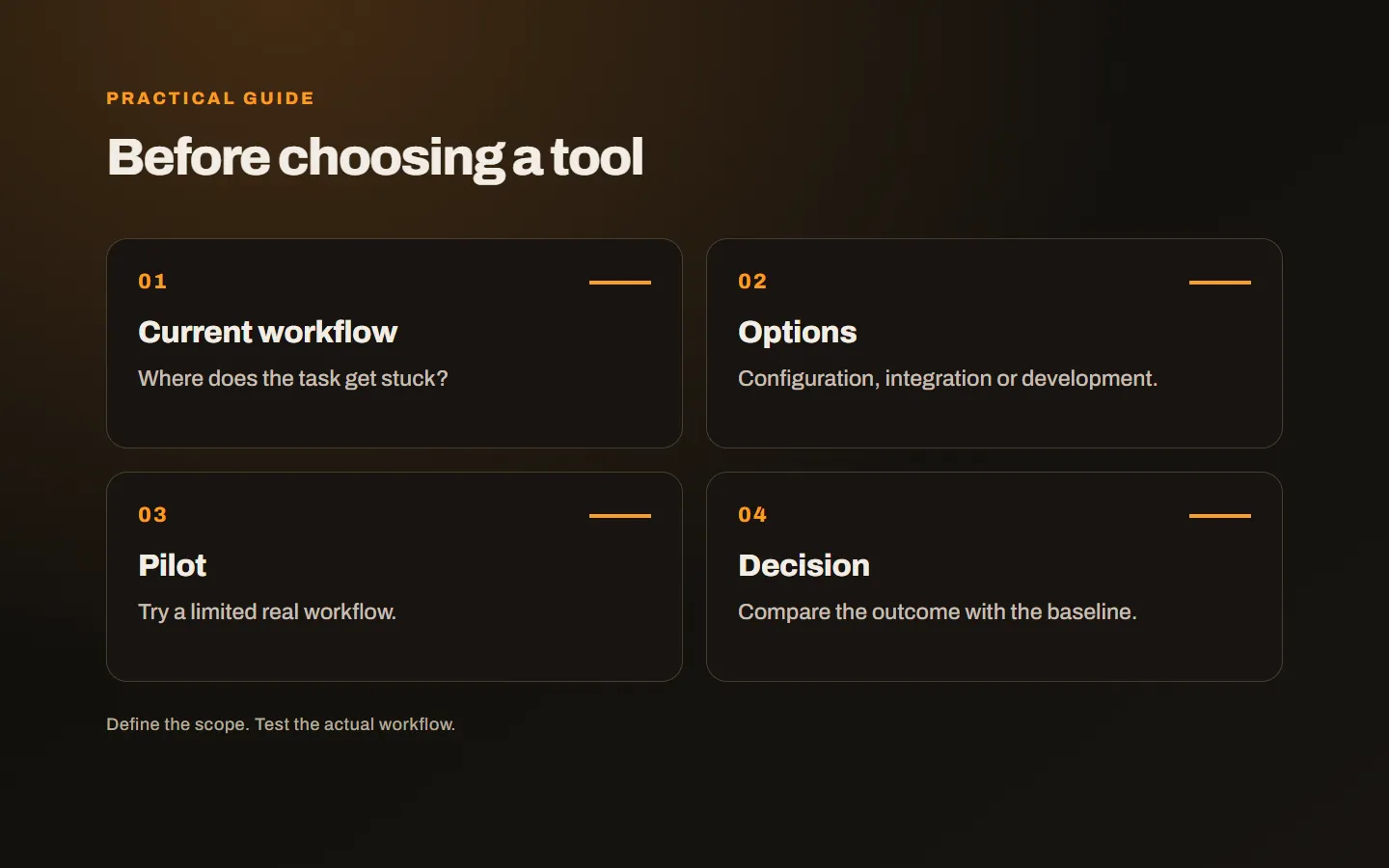
Start with “Which task gets stuck, where and with what consequence?” rather than “Which product should we buy?” The answer could be a better configuration, a small integration or custom development. A new platform is not always required.
Recognise the signs worth investigating
Common signals include conflicting customer records, monthly manual report assembly and work that depends on one employee’s memory. Another is buying tools that the team abandons in favour of old spreadsheets.
Collect specific examples rather than a general complaint about wasted time. Record the repeated action and who is involved. You can usually describe the workflow with anonymised examples before sharing sensitive business records.
These signs justify investigation; they do not automatically justify a large implementation project.
Prepare a practical picture of your current setup
List the tools you use, the jobs they perform and the people who access them. Include known renewal costs and external service arrangements. Initial discovery may use screen sharing and sample records without distributing administrator credentials.
Walk through one complete job: enquiry, proposal, approval, delivery and invoicing. Explain where information is entered and checked. Include exceptions such as cancellation, a changed customer request or late payment.
Involve daily users as well as decision-makers. A manager may need a report, but somebody must be able to enter reliable data without unnecessary effort. A system chosen solely from management expectations can fail in everyday use.
Ask for concrete deliverables
Depending on scope, useful outputs include a workflow summary, prioritised problems, evaluated options and a recommended starting plan. A product link alone does not explain why that choice suits your business.
Recommendations should state their assumptions. If the plan depends on obtaining order data from an existing system, confirm the relevant access. Missing APIs, licence restrictions and inconsistent records can change feasibility and cost.
Agree on acceptance criteria. “Sales can open a job without retyping the enquiry” describes an observable result. A broad statement about completing digital transformation does not identify what will be delivered.
Compare configuration, integration and development
A standard requirement may fit an existing product. A missing connection between two systems may need a narrower integration. Unique approval rules or calculations may support a custom solution.
Compare more than initial setup prices. Consider licensing as the team grows, data migration, training, ongoing support and the ability to export information if you leave. A low entry price does not necessarily mean a low operating cost.
For customer management decisions, our questions to ask when choosing a CRM provide a practical example. Other workflow problems may belong to inventory, scheduling or job management instead.
Validate the recommendation with a pilot
Choose one team or a limited workflow. Record the starting conditions, the outcome you want to observe and the decision that follows the pilot. Avoid continually adding features before evaluating whether the proposed approach works.
If the goal is less repeated entry, compare the same task before and after. Note which steps disappear, which errors remain and where users struggle. Not every useful finding needs to be expressed as a percentage.
Decide who accepts the pilot and what happens if it reveals an unexpected dependency. A limited trial might show that old records need cleaning before any tool can help. That is a useful finding, provided it becomes an owned action rather than an unexplained delay. Keep the original scope visible, record additional requests separately and agree whether they are essential for evaluation. A pilot should support a decision; it should not become an open-ended implementation with no point at which anyone reviews the outcome.
Clarify who implements and supports the result
Will the adviser configure the system, clean the data and train users? Where do problems go after launch? A report-only engagement can be useful, provided that is the agreed scope and implementation responsibilities are understood.
If the solution involves development, review our custom software service. Tell us which tools you use and which task repeats most often, so we can start with the workflow and assess the available options.