
If the last available item sells on two channels, remembering to update a number is only part of the problem. You need to decide which system owns stock and how changes move between systems. Integration starts with those rules, product identity and a plan for failures.
Recognise the limits of manual updates
Manual tracking can suit a small catalogue with one channel. Adding variants, a physical shop and marketplaces means updating the same information in several places. Delays between those updates can create differences even when staff follow the process.
Record recurring problems: cancelled orders not releasing stock, unavailable products remaining purchasable or employees comparing files every morning. Those observations form a better scope than simply wanting the same integration as a competitor.
Order volume is not the only consideration. A small number of unique or expensive products can make a stock mistake costly. A large but slow-moving catalogue may need different controls.
Choose the source of truth
The authoritative quantity might live in a warehouse system, accounting platform or integration service. What matters is an explicit decision. Two systems repeatedly overwriting the same field can create loops and inconsistent results.
Ownership can vary by field. The website team might own descriptions, accounting own cost data and the warehouse own available quantity. Write down which information moves in which direction instead of saying that everything will synchronise.
For example, a scheduled import should not overwrite a description that is intentionally maintained on the website. A warehouse correction should reach the channels that use its stock. These are business decisions as well as development details.
Map products and variants first
Names are unreliable identifiers because channels can name the same item differently. Use consistent product codes where possible. If colours, sizes or capacities carry separate stock, mapping must reach that level.
A single stock total for every colour can conceal that one colour has sold out. Packs and sets also need rules: a three-pack and a single item may consume the same underlying inventory.
Prepare records of:
- Product and variant identifiers in each channel.
- Unmatched and duplicate matches.
- Inactive or archived listings.
- Sets that share component inventory.
- The person responsible for manual corrections.
Test a representative sample before connecting the entire catalogue. Automation can spread an incorrect mapping faster; it does not fix it.
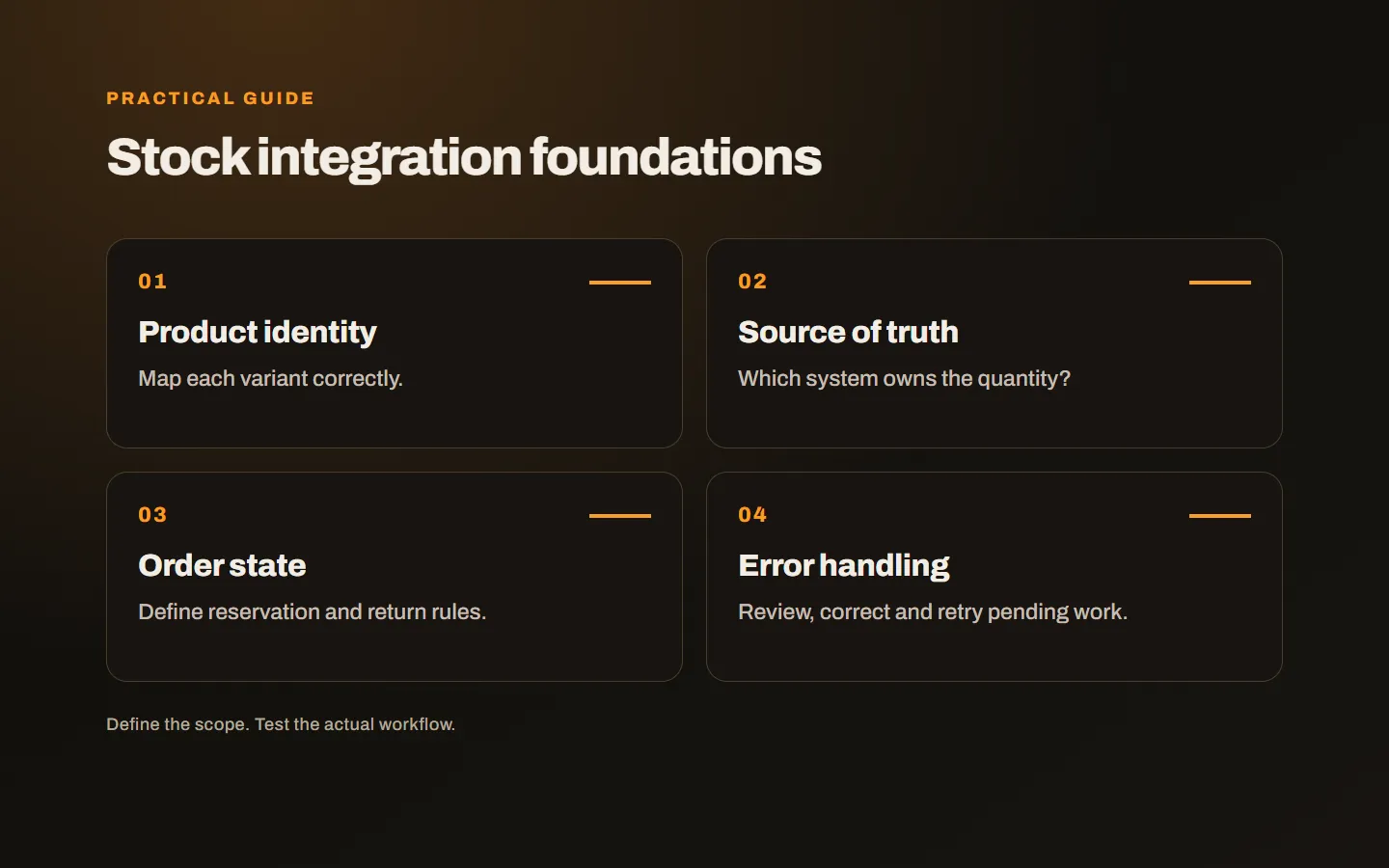
Define when stock is reserved and released
Adding to a basket, beginning payment and receiving payment confirmation are different events. Agree when stock is reserved and what happens after failed payment. The appropriate rule depends on the store’s commercial and payment model.
Cancellation and return are different too. A returned item may need inspection before it can be sold again. Receiving a return notification should not necessarily reopen available stock immediately.
Include partial cancellation and partial return scenarios. An integration that watches only the overall order status can miss changes to individual lines.
Clarify what real-time means
One service may send events while another is checked periodically. API limits, network faults and processing delays can affect updates. Ask which event reaches which destination and how the operation is confirmed.
Depending on the business, channel allocations or safety stock may help manage residual delay. They do not repair bad product mapping. Establish correct data and rules first.
Repeated notifications should not create duplicate orders. Failed transfers should have a defined retry path, with enough status information for the operator to understand the outcome without handling low-level messages.
Make errors visible and actionable
A green connection indicator does not prove every product transferred correctly. The team should see the last successful update, pending work and records needing attention. Assign responsibility for those exceptions.
If a product identifier is missing in a destination, the failure should not disappear silently. It needs an understandable record, a correction and a retry. Periodic stock reconciliation can catch differences that event processing missed.
Give the operator a clear route for resolving exceptions. They should know which corrections they can make, which need a developer and how to confirm the update succeeded afterwards. Include these responsibilities in the handover. An integration with no owner for unmatched records can leave the business doing the same manual checking it intended to remove, even while the underlying connection remains technically available.
Test the complete business scenarios
Run a normal order, failed payment, cancellation, partial return and manual stock correction. Include variants and bundles. Compare each system and confirm which record is authoritative.
If your store is still being planned, our e-commerce preparation guide covers the broader decisions. Integration method and pricing should follow an examination of the systems and access involved.
Our e-commerce service considers the storefront and the operation behind it. Tell us which channels you use and how you track stock today, so we can define data ownership before choosing the integration.