
“Technical support included” does not explain which work will be done or how requests are handled. Backups, updates, content changes and new features are different responsibilities. A useful maintenance scope makes those boundaries explicit and relates them to the work your website performs.
Identify the business tasks being protected
A brochure website differs from a system handling orders, bookings or member accounts. Changing data, external services and staff usage affect the support plan. List critical tasks before comparing package names.
A contact form can be important to a service website. A store may also depend on payment notifications and stock transfers. Monitoring should reflect those tasks. Reusing the same generic checklist for every application can leave important failures undetected.
Record ownership alongside each task. Hosting, development and content may be handled by different people. Decide who receives the initial report and coordinates the relevant specialists. The business user should not need to diagnose the technical layer before asking for help.
Understand how updates are applied
Depending on the platform, updates can involve the main application, extensions, libraries and runtime environment. Applying every change straight to production may be inappropriate, especially with custom components and dependencies.
Ask whether the service includes preparation, a suitable backup, testing where necessary and checks afterwards. A version change can affect a form or checkout. “Updated” should be accompanied by confirmation that relevant tasks still work.
An unsupported legacy system may need more than routine updates. A wider upgrade or replacement can require its own assessment. Do not silently assume that an ongoing maintenance fee covers an unspecified redevelopment project.
Define the backup and recovery scope
A file backup may not include the latest database records. A database archive may not include uploaded images or environment settings. Learn which components are protected, where copies are held and which recovery points remain available.
Relate backup frequency to data changes. A rarely edited brochure site and a store accepting orders throughout the day may tolerate different gaps. Rather than apply one interval to every application, discuss what records could be missing after recovery.
Ask how restoration is tested and who performs it. An archive being created does not establish that the application can be recovered. Required access, settings and compatible versions must be available together. Also consider whether the backup location depends on the same failure as the main system.
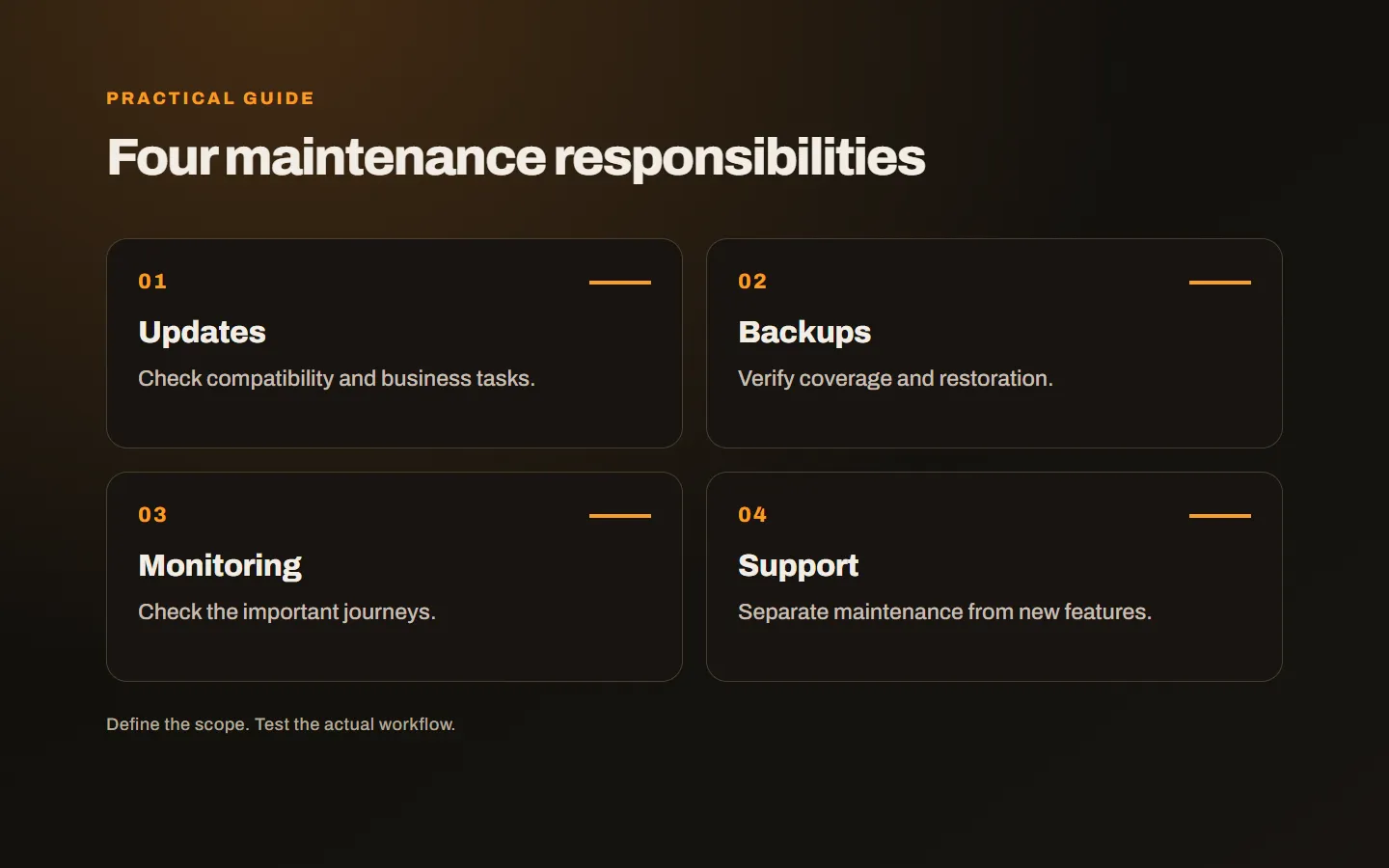
Know what monitoring can detect
A server answering a request is a useful basic check, but does not demonstrate that every function works. The homepage can open while form notifications fail. Choose checks around the business’s important journeys and understand their limits.
Domain and certificate expiry may also be relevant. Confirm whether reminders, renewal work and verification are included. Sending a reminder is not the same as completing renewal. Identify who authorises payment and confirms the result.
If error records are inspected, limit unnecessary sensitive information and control access. Monitoring exists to identify and resolve operational problems, rather than collect extensive detail about every visitor without a defined need.
Distinguish response from resolution
Acknowledging a request does not mean the problem is resolved in the same period. Provider incidents, data recovery and substantial development involve different dependencies. The proposal should distinguish initial review, priority and the path toward a fix.
Agree on working hours, emergency definitions and the support channel. Treating every text edit as urgent makes genuine incidents harder to prioritise. Conversely, a stopped checkout should not be handled as an ordinary content request.
Do not interpret a broad support statement as an exact recovery commitment. Ask for the practical procedure: what information the team needs, who coordinates external providers and how the business receives progress updates.
Separate content editing from new functionality
Changing a telephone number, designing a new page and adding a booking module are different tasks. If the package includes content work, define its limits and request process. An unlimited-support phrase is ambiguous without those boundaries.
For development requests, describe the problem, expected behaviour and acceptance criterion. If separate pricing applies, the reason should follow the scope. That distinction makes it clear what ongoing maintenance delivers and what becomes a new project.
Also consider a future provider change. An account inventory, recent checks, open issues and relevant documentation help a new team begin. Agree which access is removed and which subscriptions remain with the business. Handover should not only become a topic after a disagreement.
Keep a useful maintenance record
A long report is unnecessary, but record actual updates, backup and check status, significant findings and decisions still required. Repeating generic monthly text does not show what was done.
If work depends on an approval, explain the consequence. An expired licence, missing account or unsupported extension may prevent the next action. Make the dependency visible so the business knows what it must resolve.
If infrastructure is also changing, our website migration checklist covers email, backups and final data transfer. Our web design service considers post-launch requirements with project scope. Share the tasks your site performs and your current support arrangements, and we can clarify appropriate maintenance responsibilities.