
“How much is a website?” has no single answer, because jobs sold under the same name are not alike. When you get three quotes from three agencies and see a big gap, it is usually because one has a different scope from the other. This post explains what drives the price and what to look at when comparing quotes. We give no figures; any number given without knowing the need misleads.
Eight items that set the price
- Design approach. A site built on a ready-made theme and an interface drawn from scratch need different effort. We explain when each makes sense in ready-made theme or custom design.
- Number of pages and templates. Page types matter more than page count: dozens of product pages are one template, five different custom pages are five.
- Features. Booking, payment, listing management, membership, user panels: each means development work. An ordinary corporate site and a hotel site with bookings are not in the same category.
- Content. Who prepares copy, photos and video? If the content is ready, the process is shorter; if the agency produces it, it is an added item.
- Number of languages. Each language means translation, review and separate pages.
- Integrations. Connections to payment, shipping, accounting, CRM, maps or booking systems are separate work.
- SEO and performance. Are technical foundation, speed, structured data and redirects in the quote, or left “for later”?
- Schedule and revisions. Rushed jobs cost more; the number of revision rounds included also matters.
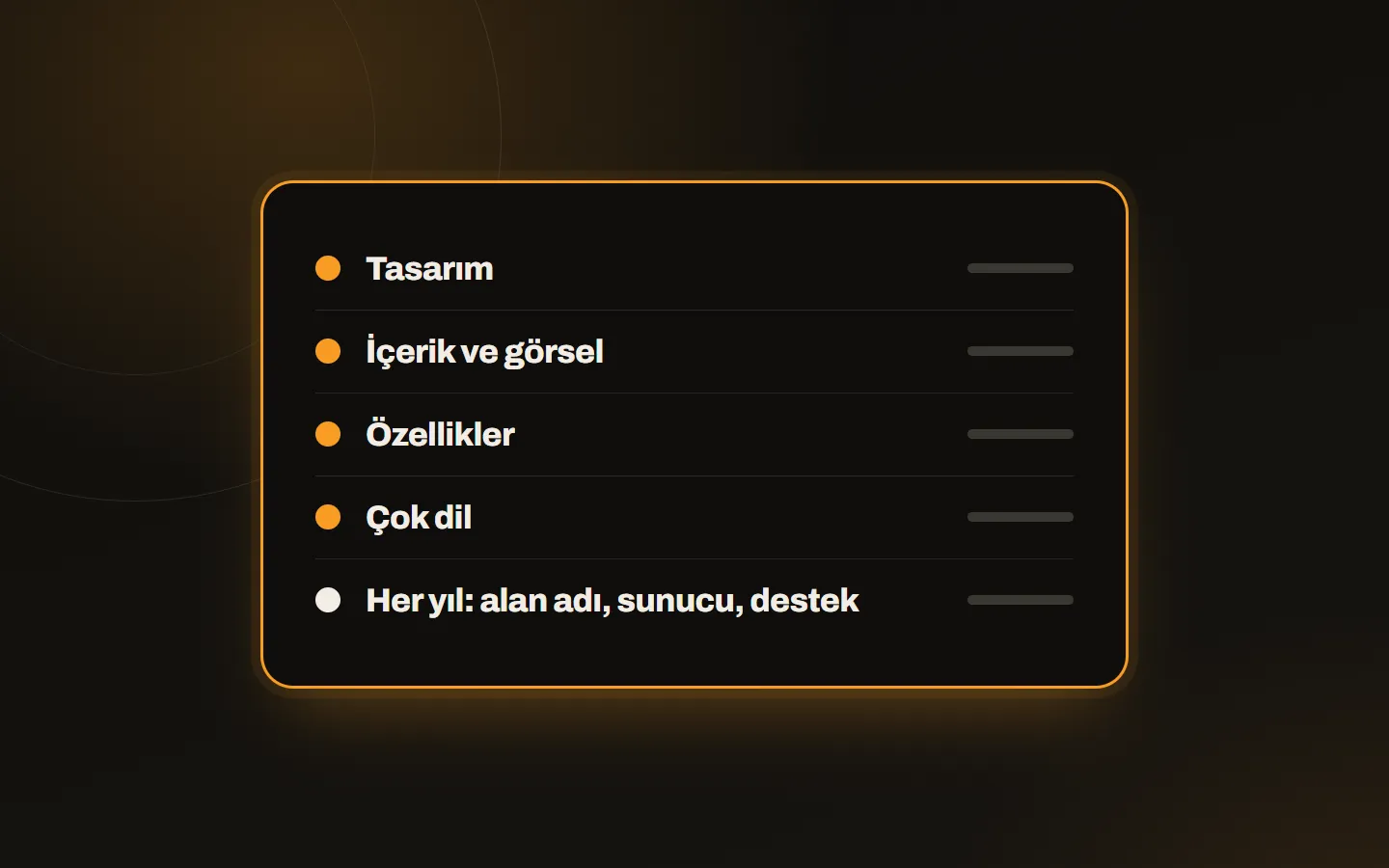
Separate one-off and yearly costs
A site is built once but kept alive every year. In the quote, check how these appear:
- Domain name: the yearly renewal fee and in whose name it is registered. It should be in yours.
- Hosting: yearly fee, capacity and backups.
- SSL certificate: usually included, but ask.
- Maintenance and support: are fixes, updates and changes after launch included, or charged per hour or request?
These are the items that change all the time and are forgotten most often; ask about the cost of later years as well as the first.
Questions to ask when comparing quotes
- How many different page types will be designed?
- Is mobile design in scope or just “will be responsive”?
- What content is expected from me (copy, photos)?
- Is there an admin panel? Can I edit text after launch?
- Who owns the source code and content? Can I take it if I move to another team?
- What are the revision rights and the delivery schedule?
- How does support after launch work, and for how long?
- What is done for SEO: titles and descriptions, redirects, speed, structured data?
Most importantly, ask for differently priced quotes against the same written brief. To start a brief, use 9 things to settle before commissioning a website.
When does the cheapest quote get expensive?
- If the scope is kept thin, every later request gets a new price.
- If speed and mobile fit are left out, you fix them after launch. We explain why it matters in our speed checklist.
- If the agency owns the source code or domain, leaving means starting over.
This is not true of every cheap quote, but if the answers to these questions are not in writing, a low price often means a missing scope.
How we work
Since 2003 we have run design, coding and launch as one team. You can find what our web design service covers, and the process when custom software is needed, on the service pages.
If you have a quote in hand or a new project in mind, write to us and we will pin down the scope together. You can see earlier work on the references page.