
Two proposals that promise to connect the same applications may describe very different work. One could transfer customer records while another also handles order updates and failed operations. To compare them fairly, establish the data flow, business outcome and responsibilities before counting screens or line items.
Describe the job you need to finish
Explain the repeated task rather than only naming two programs. Perhaps staff copy website enquiries into an accounting system. The desired outcome is not simply a connection; it is accurate information reaching the correct record without unnecessary re-entry.
Define where the process starts and ends. Does a submitted enquiry create a customer, or does an approved sale create an order? Where can staff see completion? Without an agreed endpoint, a connection might be technically available while the business still cannot finish the intended job.
Bring daily users and decision-makers into the same example. Management may want reporting while staff need to remove repeated entry. Both can form part of one integration, but neither should remain an unspoken assumption in the proposal.
Specify which information moves in which direction
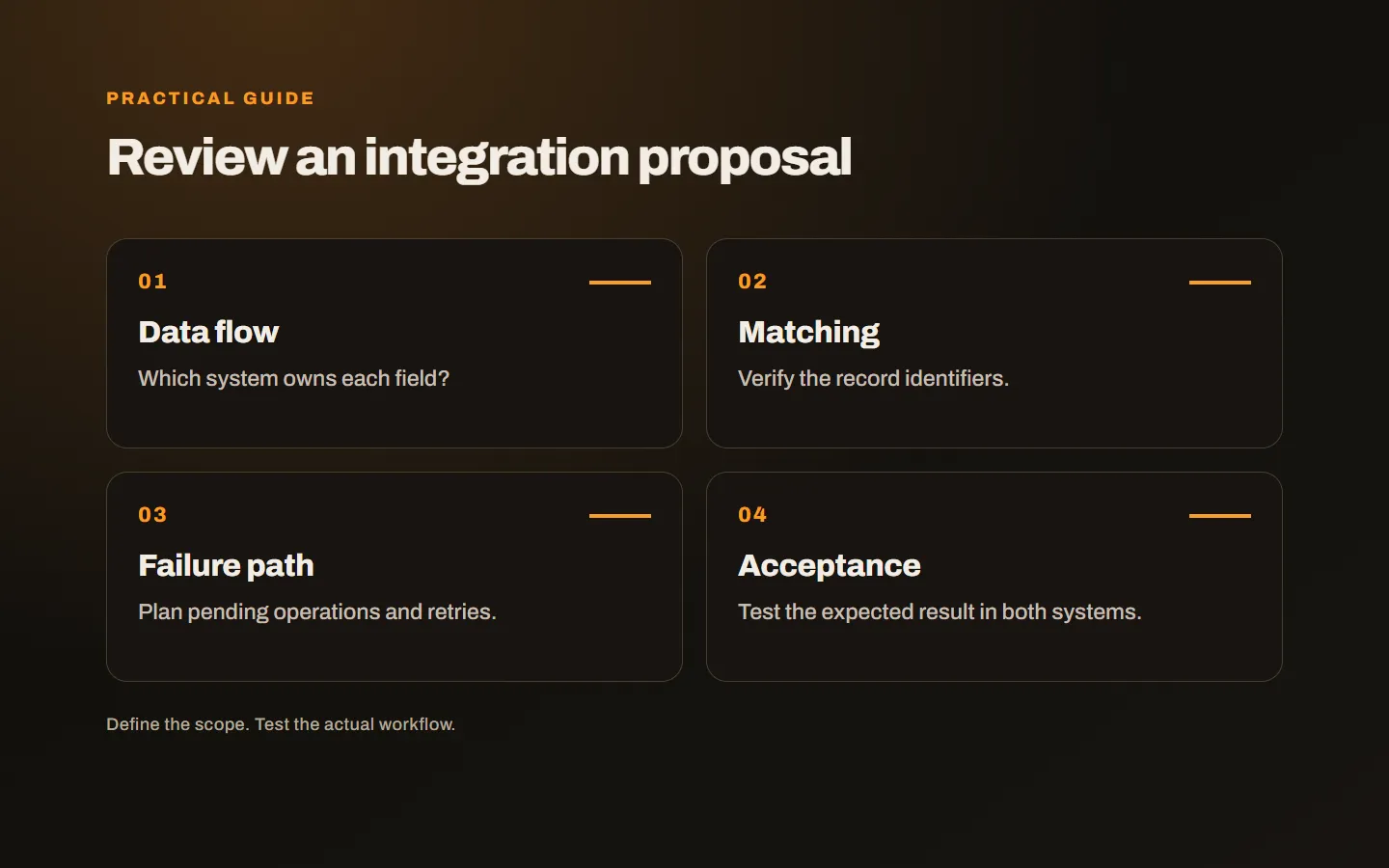
“Two-way integration” does not define responsibility. Identify the owner of names, addresses, order states, prices and quantities. Every field does not necessarily need editing at both ends. Write down where each item is maintained.
For example, a short description from accounting should not overwrite a carefully maintained website explanation unless that is the intended rule. If accounting owns prices, decide what happens to a temporary website adjustment. Automatic transfers without those rules can automate a persistent conflict.
Ask for a mapping table showing source, destination, transformation and required status. Dates, units and currencies can become operational problems if mapped incorrectly. The technical team should verify those details against representative records rather than assume they are compatible.
Confirm the necessary access exists
An application offering an API does not prove it supports every operation you require. Can the needed fields be read, new records created and existing records updated with the available permissions? Review documentation, test access and provider conditions before accepting an unconditional implementation promise.
Request limits, licensing and access arrangements can affect scope. If data can only be checked periodically, the proposal should not imply that every change appears instantly. Describe the actual behaviour in terms that match the users’ expectations.
If access depends on another provider, assign the communication task. A client-created test account, developer request or additional authorisation can affect the schedule. Record those dependencies rather than treating them as invisible time outside the project.
Establish reliable record matching
Customer and product names are not always unique. Different people can share a name, and one product can be written differently in two systems. Ask which identifiers establish a match and what happens when records appear to be duplicates.
Legacy data may need preparation. Run a small sample transfer and list missing identifiers or conflicting values. Agree which records the business cleans and which transformations the software handles. Data cleaning and connection development are related but different work items.
Define what happens when an operation fails
The failed path matters alongside the successful path. If the destination stops answering, does the record wait, retry or require intervention? Users need understandable status, and responsible staff need an appropriate error record.
Repeated notifications should not create duplicate transactions. Ask how completed work is recognised and when retrying is safe. The customer does not need to implement those safeguards, but should see that the scope includes them.
Avoid storing unnecessary sensitive information in diagnostic records. An operation identifier and suitable explanation may be enough. Access and retention should fit the application’s operational and data requirements rather than collect everything indefinitely.
Agree on acceptance examples
Choose a normal operation, missing information and an unavailable connection. Depending on the workflow, include cancellation, return or an update to an existing record. Write the expected result in both systems. A “connected” indicator is not a complete acceptance test.
Use suitable test environments for operations affecting payments or stock. If a live test is necessary, follow the business’s defined procedure. The purpose is to demonstrate a controlled outcome, not to create uncontrolled transactions.
Identify who approves each result. A developer can confirm transport, while a daily user checks that the resulting record is operationally correct. A visible amount or status can still reflect the wrong business rule. Record tested cases and unresolved exceptions in the handover.
Clarify maintenance and future changes
A connected provider may change fields, access methods or supported versions. Agree how the integration is monitored and how subsequent adaptations are handled. Initial development does not automatically include every future change, but an unowned connection is not a complete operating arrangement either.
Separate setup, testing, data preparation, documentation and support in the proposal. A smaller offer may meet your need exactly; a longer one may include unnecessary work. Compare whether the described job can be completed reliably rather than assuming more line items mean better value.
For stock and order connections, our e-commerce integration guide offers concrete scenarios. Our custom software service considers data and operations together. Tell us which systems you want to connect and which task is repeated today, and we can help define a comparable scope.