
A software feature list can grow faster than the team can deliver it. The first release needs to complete an important job reliably, with a clear boundary around what comes later. That boundary should be based on actual work rather than a collection of attractive screens.
Start with a complete job
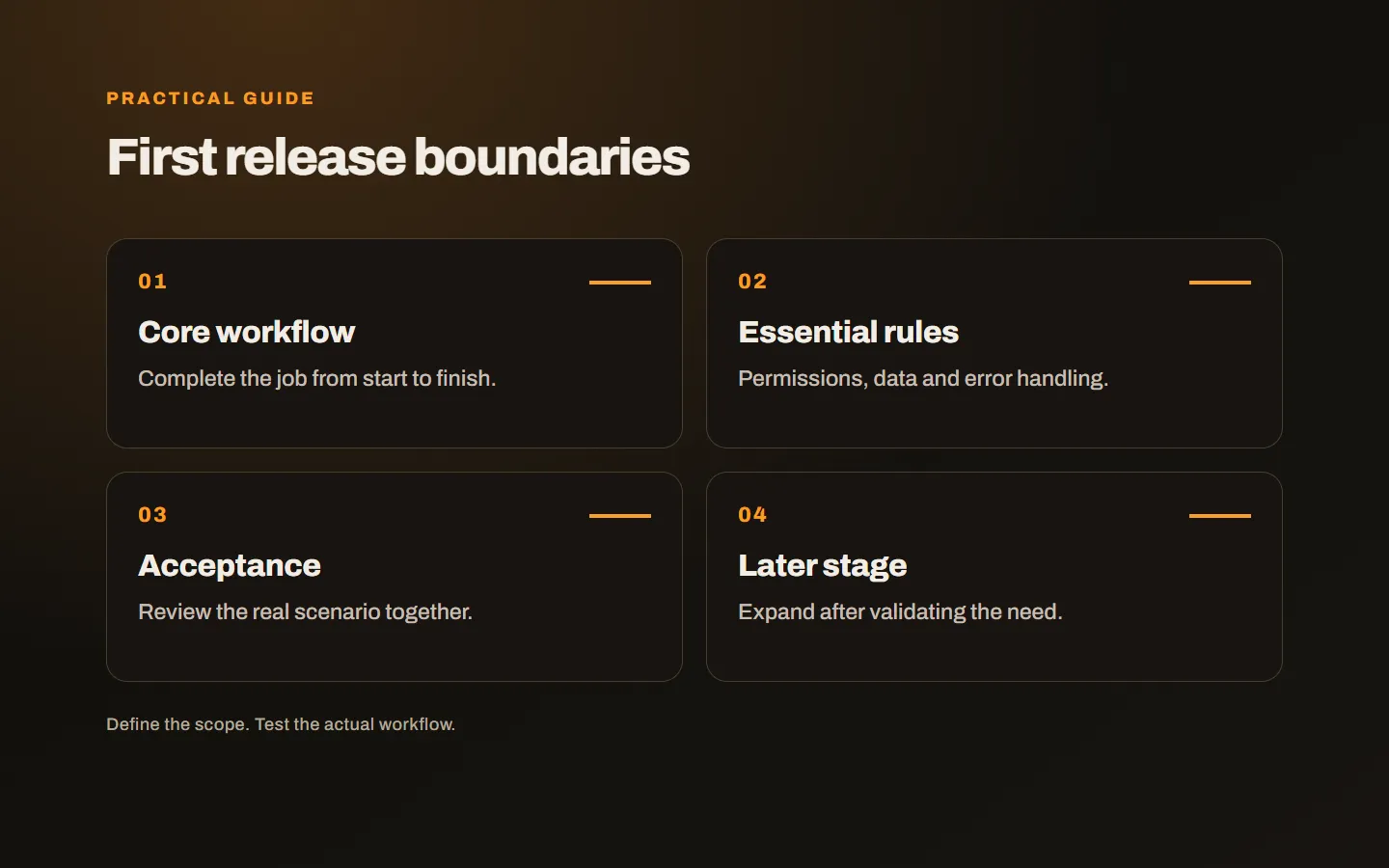
“Customers, reports, calendar and settings” is a menu, not a functional scope. Describe the job those screens support. For a service business, that might run from receiving a request through assignment, completion and notifying the customer.
Many finished screens are of limited value if the user cannot complete that journey. A smaller release that supports the whole task can be more useful. Walk through a real example before agreeing on the navigation.
Define the start and finish. What information opens a request? Who accepts it? Which status means the work is done? If colleagues still need a phone call to understand the next step, the workflow may be missing a decision.
Establish roles and permissions
Managers, field staff and customers may need different access. Essential permissions are part of the working system, rather than decorative features to add at the end.
For example, a worker might close a task without being allowed to change its price. A customer should see only their own records. The development team should enforce those rules on the server as well as in the interface.
Begin with the roles that reflect real responsibilities. Future branches and teams can inform the architecture without requiring every possible organisation structure in the first release.
Sort features by necessity
Ask whether the first user can complete the core job safely without each feature. If not, it is a candidate for the initial scope. If they can, record the benefit and the conditions for reconsidering it.
| Group | Decision | Example |
|---|---|---|
| Essential now | The core job cannot be completed reliably | Creating, assigning and tracking a request |
| Validate in use | Value exists but requirements remain uncertain | A specialist management report |
| Later stage | Opens another workflow or channel | A separate dealer portal |
Do not automatically postpone security, backups and error handling. A narrow scope can still meet the operating needs of a system handling real data.
Write observable acceptance scenarios
Replace “The report works” with a concrete example: “A manager can filter completed jobs by date and export them, excluding cancelled jobs from the total.” This tells both the developer and the reviewer what to expect.
Include exceptions. What happens when someone submits the same request twice? Can an unauthorised user open a direct link? What message appears when required information is missing? Discussing these cases early prevents avoidable scope disputes at delivery.
Use anonymised sample data. Having the client, developer and daily user review the same scenario reduces ambiguity without copying unnecessary personal records into development.
Verify integrations early
Accounting, payment and existing customer systems introduce dependencies. Confirm documentation, test access, permissions and available fields. A provider saying that it has an API does not establish that every required operation is supported.
Plan failure behaviour too. Should the operation wait, retry or alert a responsible person? Repeated messages should not create duplicate transactions. The user needs a reliable outcome without managing technical retries themselves.
If old records will move into the system, test a sample import early. Duplicates, missing fields and inconsistent dates are easier to assess from actual files. Agree who is responsible for cleaning them.
Schedule reviewable milestones
Plan a workflow review, a working core journey and an integration acceptance round. Identify who gives feedback and when. Waiting until the final delivery to reveal the complete product increases the chance of discovering incompatible assumptions.
When a new request appears, record its effect on the release. Which existing work moves, or what changes in cost? A change record should state the reason, decision-maker and accepted consequence.
Our guide to the factors behind website project quotes provides background on reading scope and price together. For software proposals, the delivery process matters more than a screen count alone.
For each milestone, identify the person who can approve the work and the daily users who should try it. A delayed decision or conflicting feedback can affect the schedule even when development itself is progressing.
Include the work after launch
Training, access handover, backups and a support channel belong in the launch plan. Clarify source code, licences, data export and which maintenance tasks are included. New features should have an agreed route for evaluation.
Our custom software service starts from the work the system needs to support. Describe the task you struggle to complete today, and we can define the boundaries of a useful first release.